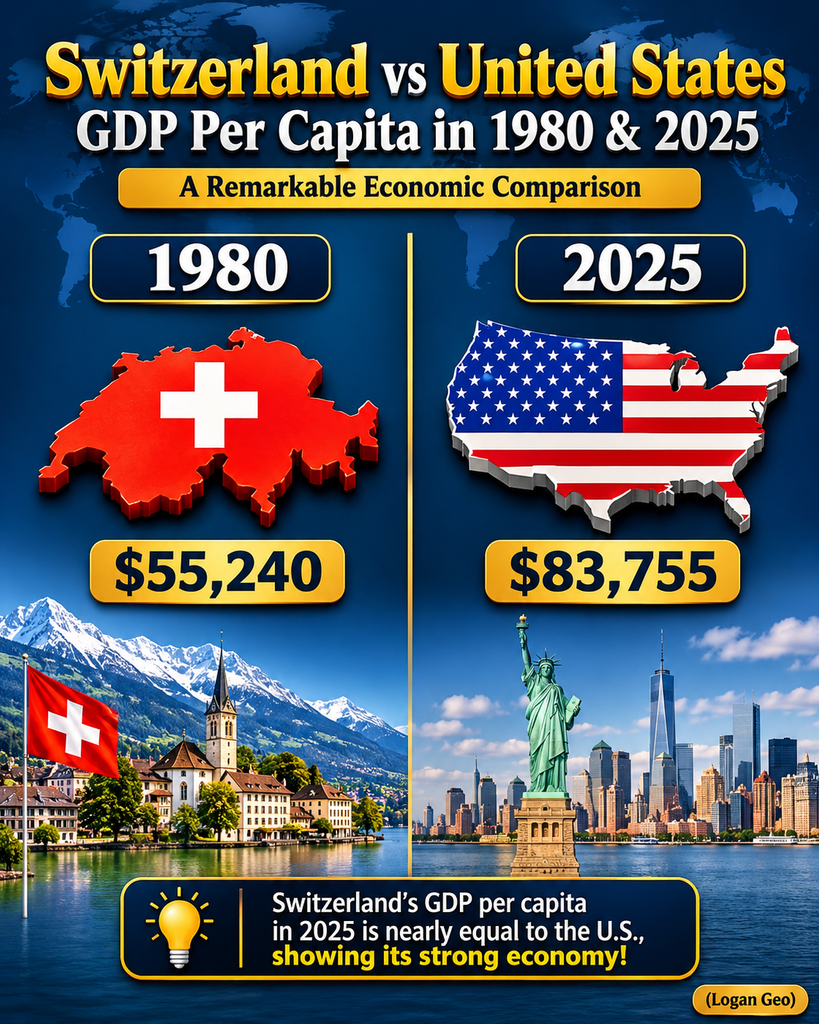
For decades, Switzerland and the United States have stood among the world’s most prosperous economies. Both countries are known for their financial strength, advanced industries, technological innovation, and high standards of living. However, their economic development has followed different paths.
A comparison of Switzerland and the United States between 1980 and 2025 reveals an interesting story about productivity, economic growth, population, and national prosperity.
Switzerland has maintained an impressive economic position despite its relatively small population, while the United States has developed one of the world’s largest and most influential economies.
But why does Switzerland have higher GDP per capita, and what makes these two countries economically different?
What Is GDP Per Capita?
Before comparing the two countries, it is important to understand what GDP per capita actually measures.
Gross Domestic Product (GDP) represents the total value of goods and services produced within a country over a particular period.
GDP per capita is calculated by dividing a country’s GDP by its population.
This indicator provides a useful way to compare economic output relative to population size.
However, GDP per capita does not represent the average salary, personal wealth, or amount of money every resident receives.
It is an economic indicator, not a direct measurement of individual living standards.
There are also different ways to calculate it. Nominal GDP per capita uses current prices and exchange rates, while inflation-adjusted GDP per capita helps compare economic output across different years. Purchasing Power Parity (PPP) additionally adjusts for differences in prices between countries.
Understanding these distinctions is essential when comparing figures from 1980 and 2025.
Switzerland: A Small Country With a Powerful Economy
Switzerland is geographically small, but its economic influence extends far beyond its borders.
The country has developed a highly productive economy supported by several internationally competitive industries.
1. Financial Services and Banking
Switzerland has a long-established international financial sector.
Zurich and Geneva are important financial centers, hosting banks, investment companies, insurance businesses, and other financial institutions.
Financial services have contributed to the country’s international economic position and helped establish Switzerland as an important destination for global business.
2. Pharmaceuticals and Advanced Manufacturing
Another important strength is Switzerland’s pharmaceutical and chemical industry.
Companies operating in these sectors produce medicines, medical technologies, specialized chemicals, and other high-value products.
Swiss manufacturing also includes precision instruments, machinery, watches, and advanced industrial equipment.
These industries generate substantial economic value through specialized production, research, and international exports.
3. Education, Skills, and Innovation
Switzerland has invested in education, vocational training, scientific research, and technical expertise.
Its combination of universities, research institutions, and vocational education helps develop a skilled workforce.
This contributes to productivity and supports industries that depend on specialized knowledge.
4. International Trade
Although Switzerland is a relatively small country, it is deeply connected to international markets.
Its companies sell products and services worldwide, allowing the country to participate in global supply chains.
Its location in central Europe also provides access to important European markets.
The United States: A Different Model of Economic Strength
The United States has a much larger population and a considerably bigger overall economy.
Its economic strength comes from a broad combination of industries, natural resources, technological leadership, consumer demand, and international trade.
1. Technology and Innovation
The United States is home to some of the world’s most influential technology companies.
Its technology sector includes software development, artificial intelligence, cloud computing, semiconductor research, and digital services.
Major technology centers such as Silicon Valley have played an important role in shaping the modern global economy.
American universities, research laboratories, and private companies also contribute significantly to scientific and technological innovation.
2. A Large Consumer Market
The United States has one of the largest consumer markets in the world.
Its population creates enormous demand for housing, transportation, healthcare, entertainment, financial services, and consumer products.
This domestic demand supports businesses across many industries.
3. Manufacturing and Energy
American manufacturing includes automobiles, aerospace equipment, electronics, machinery, chemicals, and industrial products.
The country is also a major producer of oil and natural gas.
Its energy resources have become an important component of its economic strength.
4. Financial Markets
New York is one of the world’s most important financial centers.
American financial markets influence investment, business financing, international trade, and economic activity around the globe.
The country’s financial system helps support businesses ranging from small companies to major multinational corporations.
Switzerland vs United States: What Do the 2025 Numbers Show?
For a consistent inflation-adjusted comparison, World Bank data expressed in constant 2015 US dollars provides a useful reference.
The 2025 figures are approximately:
- Switzerland: $93,328 per person.
- United States: $67,946 per person.
These figures indicate that Switzerland produced more economic output per resident, on average, than the United States in 2025.
The difference is approximately $25,382 per person.
However, this does not mean that every Swiss resident earns more than every American.
GDP per capita is an average national economic measure. It does not show how income is distributed among households or account for every difference in living costs.
For another perspective, purchasing-power-parity measurements adjust for differences in the prices of goods and services between countries. These figures can produce different comparisons.
Why Can Switzerland Have Higher GDP Per Capita?
One major reason is the structure of its economy.
Switzerland has a relatively small population and several highly productive, specialized industries.
Its pharmaceutical, financial, precision manufacturing, and professional services sectors generate considerable economic value.
The United States, meanwhile, has a much larger and more diverse economy.
Its economic activity includes enormous domestic markets, global technology companies, manufacturing, agriculture, healthcare, finance, and many other sectors.
Population size alone does not determine GDP per capita. What matters is the relationship between total economic production and the number of people.
A country can have a smaller overall economy but higher output per person.
This helps explain why Switzerland can outperform the United States on GDP per capita while the American economy remains substantially larger in total GDP.
What Has Changed Since 1980?
The period between 1980 and 2025 includes major transformations in both countries.
In 1980, the global economy was still heavily influenced by traditional manufacturing, industrial production, banking, and international trade.
Over the following decades, technological advances transformed economic activity.
Computers, the internet, telecommunications, automation, and digital services created entirely new industries.
Switzerland strengthened its position in pharmaceuticals, precision manufacturing, financial services, and research-intensive industries.
The United States expanded its influence in computing, software, digital platforms, advanced technology, and global financial markets.
Both countries also experienced economic challenges, including financial crises, recessions, changing trade conditions, and periods of inflation.
Despite these challenges, their economies continued to evolve.
Does Higher GDP Per Capita Mean a Better Quality of Life?
Not necessarily.
GDP per capita is useful, but it cannot tell the complete story about life in a country.
Other factors are equally important when examining living standards.
These include:
- Healthcare access and affordability.
- Housing costs.
- Education opportunities.
- Employment conditions.
- Income inequality.
- Transportation and infrastructure.
- Personal purchasing power.
- Work-life balance.
Switzerland is known for its high wages and strong public infrastructure, but it also has expensive housing and everyday living costs.
The United States offers a large range of economic opportunities, but living conditions and access to services can vary considerably between states and communities.
A complete comparison therefore requires more than one economic statistic.
Frequently Asked Questions
1. Is Switzerland richer than the United States?
Switzerland has higher GDP per capita in the 2025 inflation-adjusted comparison discussed here. However, the United States has a much larger total economy.
2. What is GDP per capita?
GDP per capita measures a country’s total economic output divided by its population. It is commonly used to compare economic production relative to population size.
3. Why is Switzerland’s GDP per capita so high?
Its highly productive industries, including pharmaceuticals, financial services, precision manufacturing, and specialized exports, contribute to its strong economic output per resident.
4. Does GDP per capita represent average salary?
No. GDP per capita measures economic production per person, not individual earnings. Wages, household income, and wealth are different economic measurements.
5. Which country has the larger economy?
The United States has a much larger total GDP than Switzerland because of its considerably larger population and broader economic base.
Conclusion: Two Different Paths to Prosperity
Switzerland and the United States demonstrate that economic success does not follow just one formula.
Switzerland has built a highly productive economy through specialized industries, financial services, advanced manufacturing, research, and international trade.
The United States has developed a much larger and more diversified economy supported by technology, consumer demand, financial markets, manufacturing, and innovation.
Their economic development since 1980 highlights two different approaches to prosperity.
Switzerland demonstrates the strength of a small, highly productive economy, while the United States demonstrates the enormous economic potential of a large and diversified market.
Ultimately, GDP per capita offers an interesting way to compare these countries, but understanding their economic differences requires looking beyond a single number.
Which economic model do you find more impressive: Switzerland’s high output per person or America’s enormous overall economy?