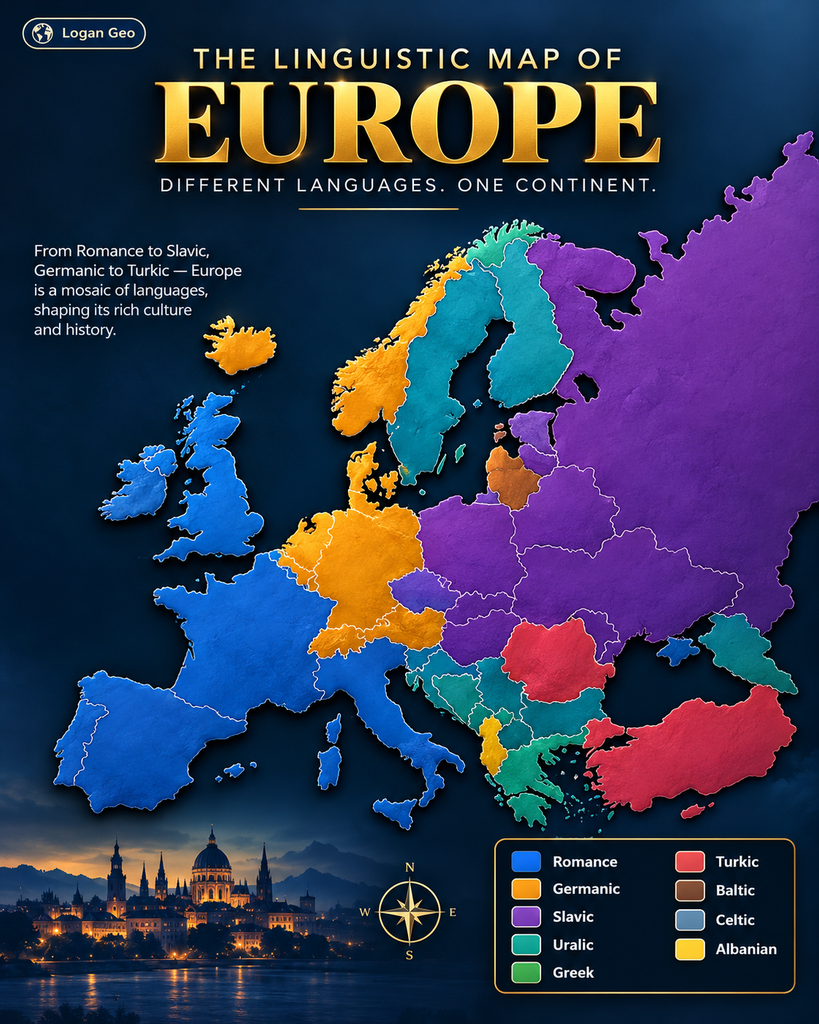
Europe is a continent of remarkable linguistic diversity. Travel from France to Germany, from Poland to Finland, or from Greece to Turkey, and you will encounter languages that sound different, follow different grammatical rules, and reflect very different historical journeys.
Yet these languages are not simply a collection of unrelated ways to communicate. Many share ancient roots, while others belong to entirely different language families. Understanding these connections helps explain Europe’s cultural history, migration patterns, and regional identities.
A map of Europe’s main language groups offers a useful starting point. But the real story becomes much more interesting when we look beyond national borders and explore how languages developed over thousands of years.
What Is a Language Family?
A language family is a group of languages descended from a common ancestral language. Over generations, communities become separated, pronunciation changes, vocabulary develops, and grammatical structures evolve. Eventually, related varieties can become distinct languages.
Linguists study these relationships by comparing vocabulary, grammar, and sound patterns. Similarities between languages can reveal connections that are not immediately obvious to someone hearing them for the first time.
Many of Europe’s most widely spoken languages belong to the Indo-European family. Others, including Finnish, Hungarian, and Estonian, belong to the Uralic family. Turkish belongs to the Turkic family, while Basque is generally classified as a language isolate, meaning that no established relationship with another living language family has been demonstrated.
These distinctions show why a language map is more than a collection of country colors. It represents centuries of linguistic change and contact.
1. Romance Languages: The Legacy of Latin
The Romance language group developed from Latin, the language associated with ancient Rome.
As Roman power and Latin spread across large parts of Europe, regional varieties developed in different communities. Over time, these varieties evolved into languages such as French, Spanish, Portuguese, Italian, and Romanian.
Although these languages are distinct, they retain many recognizable similarities. For example, the Spanish word familia, the Italian famiglia, and the French famille share a common historical origin.
Romance languages are especially prominent in southwestern Europe, including the Iberian Peninsula, France, and Italy. Romanian demonstrates that the family extends into southeastern Europe as well.
Their distribution reflects the long-term influence of the Roman world, but it also reflects later political, cultural, and social developments. Modern Romance languages are not simply unchanged versions of ancient Latin; each has its own history and identity.
2. Germanic Languages: From Northern Europe to the Wider World
Germanic languages form another major branch of the Indo-European family.
English, German, Dutch, Danish, Swedish, Norwegian, and Icelandic are examples. Their relationships become clearer when vocabulary and grammar are compared.
For instance, English house, German Haus, and Dutch huis have closely related forms. Such similarities are evidence of shared linguistic ancestry rather than proof that one modern language directly developed from another.
Germanic languages are widespread in northern and western Europe. English has also spread globally through historical migration, colonization, trade, education, and modern international communication.
One particularly interesting detail is that English has a Germanic foundation but contains extensive vocabulary borrowed from French, Latin, and other languages. This makes English a good example of how a language can belong to one family while absorbing influences from many others.
3. Slavic Languages: A Vast Linguistic Network
Slavic languages are another major Indo-European branch, particularly prominent in eastern, central, and southeastern Europe.
Examples include Russian, Ukrainian, Belarusian, Polish, Czech, Slovak, Bulgarian, Serbian, Croatian, and Slovenian.
Linguists commonly divide Slavic languages into three broad groups: East Slavic, West Slavic, and South Slavic. These divisions help explain similarities among neighboring languages while recognizing that each language has its own development.
Polish and Czech, for example, share West Slavic roots. Russian and Ukrainian belong to the East Slavic branch, while Bulgarian and Serbian are South Slavic languages.
Geography and historical events influenced the spread and development of these languages. Political boundaries, migration, religious traditions, and contact with neighboring populations all helped shape their modern forms.
However, linguistic relationships do not automatically determine national identity, and speakers of related languages may have very different cultural and historical experiences.
4. Uralic Languages: Finland, Estonia, and Hungary
One of Europe’s most interesting linguistic contrasts involves Finnish, Estonian, and Hungarian.
These languages belong to the Uralic family rather than the Indo-European family. Finnish and Estonian are closely related, while Hungarian represents a different branch of the family.
Geographically, Hungary is separated from Finland and Estonia by large distances. Nevertheless, the languages share a deeper historical relationship.
This is an excellent example of why geography alone cannot explain language distribution. Linguistic ancestry reflects older population histories and long periods of change, not simply the locations of modern countries.
Finnish and Estonian also illustrate another important point: neighboring populations may speak languages from different families. Swedish, a Germanic language, is spoken in Sweden and also has official status in Finland alongside Finnish.
5. Baltic, Celtic, Greek, and Albanian
Europe’s linguistic landscape includes several other important branches of the Indo-European family.
Baltic languages: Lithuanian and Latvian are the two modern national languages most commonly identified as Baltic languages. They preserve features that make them particularly interesting to historical linguists.
Celtic languages: Irish, Welsh, Scottish Gaelic, and Breton are examples of Celtic languages. Their present-day distribution reflects a long history of change, and some Celtic languages have smaller speaker communities than the major national languages around them.
Greek: Greek forms its own branch of the Indo-European family, often called Hellenic. It has a documented history stretching back thousands of years, making it particularly important for the study of ancient and modern European languages.
Albanian: Albanian is also an independent branch of Indo-European. It is not simply a variety of Greek or a Slavic language, despite centuries of contact with neighboring populations.
These groups demonstrate that Europe’s language history cannot be reduced to three large categories alone. Smaller branches contribute significantly to the continent’s linguistic diversity.
6. Turkic Languages and Europe’s Wider Connections
Turkish belongs to the Turkic language family, which extends across parts of southeastern Europe, Anatolia, Central Asia, and other regions.
Turkish has a significant presence in Turkey and is also spoken by communities elsewhere in Europe. Other Turkic languages, including Tatar, are present in parts of the wider European region.
The history of Turkic languages illustrates how migration, empires, trade, and cultural contact have connected Europe with neighboring parts of Asia.
It is also important to distinguish a country’s geographic position from the language family spoken by its population. Turkey spans southeastern Europe and western Asia, while the Turkic family extends far beyond the borders of any single country.
Why Europe’s Language Map Is More Complicated Than It Looks
A language-family map is useful, but it can oversimplify reality if each country is assigned just one color.
Many countries contain regional, minority, and immigrant languages. Switzerland, for example, has several national languages, while Spain includes languages such as Catalan, Galician, and Basque alongside Spanish. Belgium has Dutch, French, and German as official languages.
Basque is particularly notable because it does not have an established genetic relationship with the Indo-European language family. Maltese is another important exception to simple maps of European languages: it belongs to the Semitic branch of the Afroasiatic family, although it has absorbed substantial vocabulary from Italian and English.
Language boundaries are rarely identical to political borders. Communities move, languages coexist, and multilingual speakers use different languages in different settings.
The European Union recognizes 24 official languages for its institutions, but that list does not include every regional, minority, or community language spoken across Europe.
Frequently Asked Questions
1. What is the largest language family in Europe?
Indo-European is the most widespread language family in Europe. It includes major branches such as Romance, Germanic, Slavic, Baltic, Celtic, Greek, and Albanian.
2. Are English and German related?
Yes. Both are Germanic languages within the Indo-European family. English has also borrowed extensively from French, Latin, and many other languages.
3. Why are Finnish and Hungarian different from most European languages?
Finnish and Hungarian belong to the Uralic family, not the Indo-European family. Their deeper linguistic ancestry differs from that of most widely spoken languages in Europe.
4. Is Turkish a European language?
Turkish is spoken in a country that spans Europe and Asia, and it is spoken by communities throughout Europe. Linguistically, it belongs to the Turkic family, not the Indo-European family.
5. Do language families follow national borders?
No. Related languages may be spoken in several countries, and a single country may contain multiple language families. National borders are political boundaries, not precise maps of linguistic ancestry.
Conclusion: A Continent Connected by Language
Europe’s languages tell a story of ancient ancestry, regional change, migration, cultural exchange, and continuing evolution. Romance languages preserve the legacy of Latin, Germanic and Slavic languages reveal different branches of Indo-European history, and Uralic and Turkic languages show that Europe’s linguistic landscape extends beyond a single family.
The map is a helpful introduction, but its colors cannot capture every local language, minority community, or historical connection.
Looking beyond borders reveals a more accurate and fascinating picture: Europe is not defined by one language or one linguistic tradition. Its diversity is part of what makes the continent so culturally rich.
Sources for further reading
- European Union, Languages and multilingualism: https://european-union.europa.eu/principles-countries-history/languages_en
- European Commission, Linguistic diversity in the EU: https://translation.ec.europa.eu/languages-eu-why-multilingualism-matters/linguistic-diversity-eu_en
- European Commission, A field guide to the main languages of Europe: https://op.europa.eu/en/publication-detail/-/publication/0a83dc98-fdb1-4c28-9af5-328e5e32bdd6/language-en
- National Geographic Education, Language Family: https://education.nationalgeographic.org/resource/language-family/