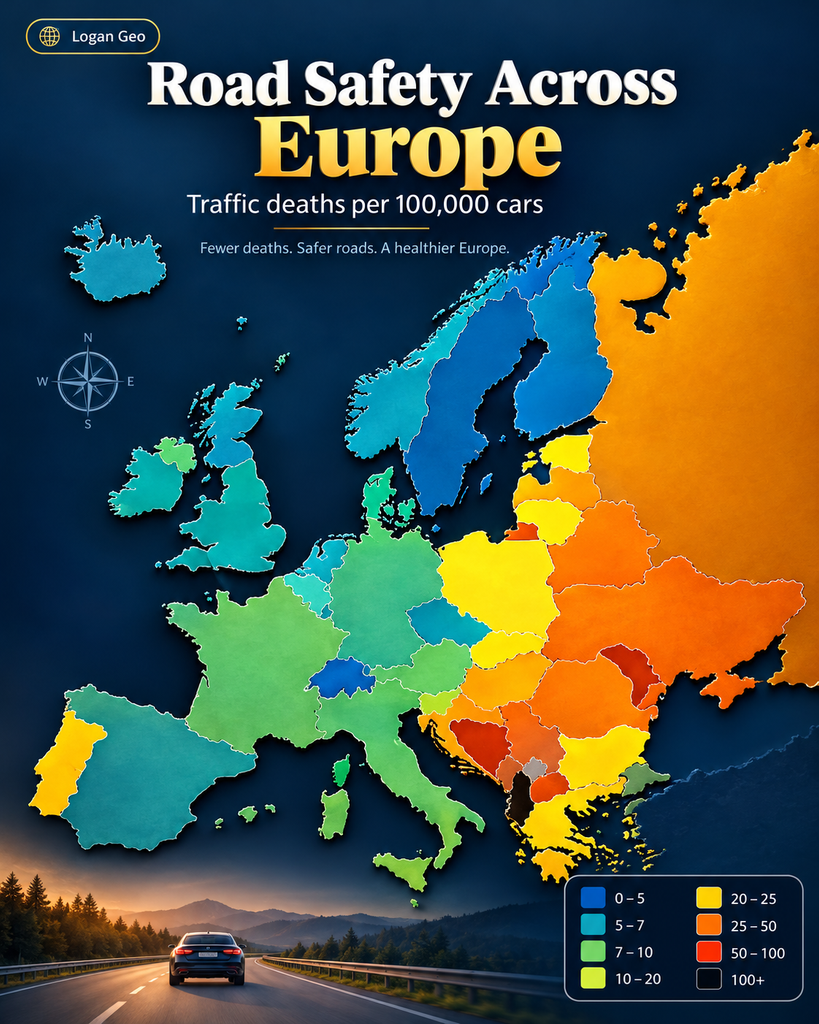
Europe’s road network connects busy capital cities, quiet rural communities, mountain passes, and major international travel routes. Yet road safety is not the same everywhere. Some countries record relatively few road deaths compared with their populations, while others continue to face significant challenges.
A color-coded map of Europe makes these differences easy to visualize. But understanding what the colors mean requires looking beyond the map itself. Official statistics, road design, vehicle safety, driving behavior, and emergency response all help explain why road safety varies from country to country.
What Do Europe’s Road Safety Statistics Show?
According to Eurostat, road traffic crashes killed 19,934 people across the European Union in 2024. That represented a 2.2% decrease from 2023, when 20,384 deaths were recorded. The EU averaged approximately 44 road deaths per million inhabitants in 2024.
The differences between countries were substantial. Sweden recorded 20 deaths per million inhabitants, while Malta recorded 21 and Denmark recorded 24. At the other end of the scale, Romania recorded 78 deaths per million inhabitants, Bulgaria recorded 74, and Greece recorded 64.
These figures illustrate an important point: road safety outcomes vary significantly across Europe, even among countries that share many regional transport standards. Source: Eurostat’s 2024 road fatality statistics.
However, these are rates per million inhabitants, not deaths per 100,000 cars. The distinction matters because different measurement methods can produce different comparisons.
Why the Measurement Method Matters
The infographic uses the phrase “traffic deaths per 100,000 cars.” That is a different measure from road deaths per million residents, which is commonly used in official European comparisons.
A population-based rate helps show the fatality burden relative to the number of people living in a country. A vehicle-based rate compares deaths with the number of cars. Another useful measure considers deaths relative to the distance people drive.
Each method answers a different question. A country with extensive daily driving may have a different risk profile from a country where people travel shorter distances. Similarly, countries with different numbers of registered cars cannot be compared fairly using raw fatality totals alone.
Because the supplied infographic does not identify its original dataset, publication year, or calculation method, its individual country colors should not be treated as verified rankings. Official statistics provide a more reliable starting point for understanding the broader picture.
What Makes Some European Roads Safer?
1. Road Design and Infrastructure
Road design can influence both the likelihood of a crash and its severity. Divided highways, protective barriers, clear road markings, safe junctions, and well-maintained surfaces can reduce certain risks.
Urban design matters too. Pedestrian crossings, protected cycling lanes, good lighting, and traffic-calming measures can help protect people who are not inside vehicles.
The safest approach does not rely entirely on drivers making perfect decisions. Roads should be designed to reduce the consequences of predictable mistakes. This principle is central to the Safe System approach promoted by the World Health Organization and European road safety authorities.
Source: European Road Safety Charter on road infrastructure.
2. Speed Limits and Enforcement
Speed is one of the most important factors in road safety. Higher speeds reduce the time available to react and increase the energy involved in a collision.
The European Commission estimates that speeding or inappropriate speed is directly responsible for around 30% of fatal road crashes in the EU. Enforcement, appropriate speed limits, and road designs that encourage safer speeds can therefore make a meaningful difference.
The correct speed also depends on conditions. A speed that may be appropriate on a clear motorway could be dangerous on a wet rural road or a crowded city street.
3. Seat Belts, Alcohol, and Driver Distraction
Individual behavior remains important, even where roads and vehicles are well designed.
Seat belts reduce the risk of fatal injuries for vehicle occupants. Driving under the influence of alcohol or drugs can impair judgment and reaction time. Mobile phone use can divert attention from surrounding traffic at critical moments.
European road safety research consistently identifies speeding, impaired driving, distraction, and failure to use protective equipment among the major risks associated with fatal crashes.
Countries can address these dangers through public education, effective law enforcement, consistent penalties, and safer vehicle technology. Drivers also have a direct role: buckle up, stay sober, put the phone away, and adjust speed to conditions.
Source: European Commission, main factors causing fatal crashes.
What the Safest Countries Can Teach Others
Sweden and Denmark recorded some of the lowest road fatality rates in the EU in 2024. Their results are worth examining, but a single statistic cannot establish why one country performs better than another.
A meaningful comparison should consider road design, travel patterns, vehicle fleets, traffic laws, compliance, and the protection available to pedestrians and cyclists. It should also examine how these factors change over time.
Countries can learn from successful policies elsewhere, but simply copying one speed limit or enforcement strategy is unlikely to solve every problem. Effective road safety policies need to reflect local conditions and be evaluated using reliable data.
Europe’s Road Safety Challenge: Progress Without Complacency
The EU has made long-term progress in reducing road deaths, but the challenge remains substantial. According to Eurostat, fatalities fell by 17.4% between 2014 and 2024.
The European Union has also established a goal of halving road deaths and serious injuries by 2030, with a longer-term ambition to approach zero road deaths by 2050. Achieving these targets will require sustained action rather than occasional awareness campaigns.
Safer vehicles, better infrastructure, responsible driving, effective enforcement, and timely emergency care all contribute to the wider effort. Progress in one area cannot always compensate for weaknesses in another.
For travelers, the practical lesson is straightforward: road conditions and risks can change significantly between destinations. Learning local rules, planning routes carefully, allowing sufficient time, and avoiding distractions can help make journeys safer.
Frequently Asked Questions
1. Which European countries had the lowest road fatality rates in 2024?
Sweden recorded 20 road deaths per million inhabitants, followed by Malta at 21 and Denmark at 24, according to Eurostat’s 2024 figures.
2. Which EU countries had the highest rates in 2024?
Romania recorded 78 road deaths per million inhabitants, Bulgaria recorded 74, and Greece recorded 64. These are population-based rates, not deaths per registered car.
3. Why do road fatality rates differ between countries?
Possible contributing factors include road infrastructure, traffic speed, driving behavior, enforcement, vehicle safety, travel patterns, and emergency response. Statistics alone do not prove which factor explains a particular country’s results.
4. Is a rate per car the same as a rate per person?
No. A rate per car compares fatalities with a vehicle count, while a rate per person compares fatalities with population. Rates based on distance driven measure a different aspect of risk.
5. How can Europe reduce road deaths further?
Measures include safer road design, appropriate speed limits, seat-belt use, preventing impaired and distracted driving, safer vehicles, and effective emergency care. These measures work best as part of a coordinated safety system.
Conclusion
Europe’s road safety map offers a useful starting point for exploring differences between countries, but reliable conclusions depend on knowing what the data actually measure.
Official 2024 statistics show that road fatality rates vary considerably across the European Union. Understanding those differences requires more than assigning colors to countries: it means examining road infrastructure, driver behavior, vehicle safety, and public policy together.
The larger lesson is that safer roads are achievable through sustained, evidence-based action. Every improvement in road design, responsible driving, and emergency response can help protect lives—regardless of which country a journey crosses.