Michael Jackson remains one of the most recognizable names in music history. From his early years as a talented child performer to his rise as an international superstar, his journey helped shape the sound, style, and spectacle of modern pop music.
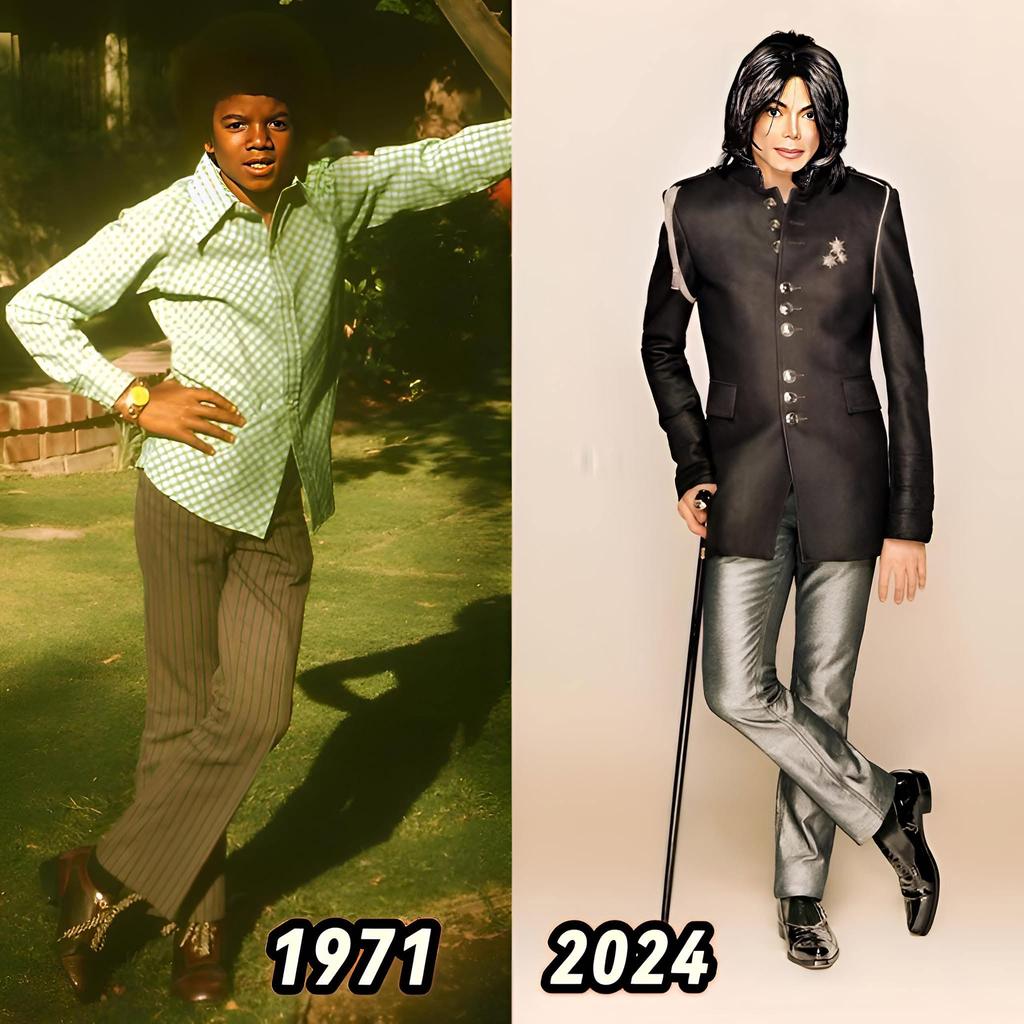
A side-by-side image labeled 1971 and 2024 captures the appeal of comparing different eras. The young figure on the left represents the early days of show business, while the dramatic black jacket and silver trousers on the right evoke the bold fashion associated with Jackson’s later public image. Although the image’s exact origins are unverified, it provides an interesting starting point for exploring his remarkable career and lasting influence.
The Early Years: A Young Performer With Extraordinary Talent
Michael Joseph Jackson was born on August 29, 1958, in Gary, Indiana. He began performing with his brothers as part of the Jackson 5 when he was still a child. The group became a major success, attracting audiences with its energetic performances, memorable songs, and impressive stage presence.
In 1969, the Jackson 5 signed with Motown Records. The group soon achieved widespread popularity with songs such as “I Want You Back,” “ABC,” and “I’ll Be There.”
Michael’s voice, timing, and natural ability to connect with an audience helped him stand out even at a young age. His early experiences performing with his brothers gave him a foundation for the solo career that followed.
By 1971, Jackson had begun releasing music as a solo artist while continuing to perform with his family. This period marked an important step in his development from a gifted young singer into an artist with ambitions beyond the group.
How Michael Jackson Became a Global Superstar
Jackson’s career continued to grow throughout the 1970s. His work in the film The Wiz and his solo album Off the Wall, released in 1979, helped establish him as a major individual artist.
The release of Thriller in 1982 took his popularity to another level. The album combined pop, rock, funk, and R&B influences, while its music videos helped demonstrate how visual storytelling could become an essential part of popular music.
Songs such as “Billie Jean,” “Beat It,” and “Thriller” became defining works of his career. His carefully rehearsed dance routines, distinctive stage presence, and detailed costumes made his performances recognizable around the world.
Jackson was no longer simply a singer. He had developed a complete performance identity in which music, movement, clothing, and visual presentation worked together.
The Fashion Choices That Defined His Image
One of the most memorable parts of Jackson’s public image was his fashion. His outfits often featured striking shapes, unusual combinations, decorative details, and accessories that made him stand out on stage.
Military-inspired jackets became particularly associated with his image. These garments often featured elaborate embellishments, prominent shoulders, decorative buttons, and metallic details.
According to the GRAMMY Museum and the Smithsonian’s National Museum of African American History and Culture, authentic jackets worn by Jackson during significant performances are preserved as part of his artistic legacy.
His fashion choices also included the famous single sequined glove, distinctive hats, fitted trousers, white socks, and carefully designed performance shoes.
These details were not merely decorative. They helped create a recognizable silhouette that audiences could identify even before hearing a song.
Jackson’s style also demonstrated how an entertainer could turn clothing into a memorable part of a performance. A jacket, glove, or hat could become as closely associated with an artist as a signature melody.
Why the Military-Style Jacket Became So Iconic
The black military-style jacket shown on the right side of the uploaded image recalls one of Jackson’s most recognizable fashion themes.
His real stage wardrobe included military-inspired garments with elaborate embroidery, metallic decoration, and strong tailoring. Costume designer Bill Whitten created important pieces for Jackson, including a black sequined silk jacket worn during the 1984 Victory Tour.
The attraction of this style came from its dramatic appearance. Structured shoulders created a powerful outline, while decorative details caught the light and emphasized movement.
Theatrical clothing also helped distinguish a live performance from an ordinary appearance. Under stage lighting, reflective materials and bold silhouettes made an outfit easier to recognize from a distance.
Jackson’s fashion was not limited to one design. He experimented with leather jackets, formal suits, glittering accessories, and futuristic costumes throughout his career.
The important connection between these looks was his willingness to make strong visual choices rather than follow conventional expectations.
The Meaning Behind a Then-and-Now Comparison
Images comparing different years are popular because they make time and transformation easy to understand. A single frame can suggest changes in fashion, age, career, and cultural influence.
In this particular image, the contrast between the casual-looking 1971 outfit and the formal, theatrical appearance on the right encourages viewers to think about how a young performer can develop a distinctive public identity.
However, the dates should be interpreted carefully. The image itself does not establish that both photographs are authentic or that the right-hand figure was photographed in 2024.
Michael Jackson died on June 25, 2009, at the age of 50. Therefore, an image portraying him in 2024 should be understood as an artistic recreation, tribute, edited image, or other representation unless its actual subject and origin can be verified.
This distinction does not reduce the image’s value as a creative comparison. It simply separates visual interpretation from documented history.
Michael Jackson’s Influence on Modern Fashion and Music
Jackson’s influence extends beyond his recorded songs. His approach to performance helped establish a model in which music videos, choreography, costumes, and stage production could form one unified artistic experience.
His fashion has also inspired designers, performers, collectors, and fans. Military-style jackets, glittering accessories, red leather outerwear, and sharply tailored trousers continue to appear in discussions of memorable pop-star looks.
Museums have preserved items from his wardrobe because these pieces offer a physical connection to important moments in music and performance history.
His influence can also be seen in the way modern artists develop recognizable visual identities. Distinctive clothing, coordinated stage design, and signature dance moves can help performers build a lasting connection with their audiences.
Fashion trends change, but Jackson’s most recognizable looks remain easy to reference because they combined bold design with a clearly defined performance persona.
Why His Legacy Continues to Attract Attention
There are several reasons Jackson remains a subject of interest years after his death.
First, his music continues to reach new listeners through recordings, streaming platforms, documentaries, and cultural retrospectives. Second, his performances created memorable images that fans continue to share and discuss. Third, his career offers a compelling example of how talent, presentation, and media exposure can combine to create an enduring public identity.
His legacy is complex, and discussions of his life should acknowledge both his artistic achievements and the controversies surrounding him. Still, his influence on popular music, dance, music videos, and performance fashion remains an important part of modern entertainment history.
A comparison like the uploaded image invites viewers to look beyond a single outfit and consider the larger story of an artist whose image became inseparable from his work.
Frequently Asked Questions
1. Who was Michael Jackson?
Michael Jackson was an American singer, songwriter, and dancer known worldwide as the King of Pop. He first gained fame as a member of the Jackson 5 before becoming a highly successful solo artist.
2. What was Michael Jackson doing in 1971?
In 1971, Jackson was still performing with the Jackson 5 and beginning to release solo recordings. His early solo work helped lay the groundwork for his later career.
3. Why was Michael Jackson known for his fashion?
He combined distinctive clothing, bold accessories, carefully planned choreography, and theatrical presentation. His military-inspired jackets and sequined glove became particularly recognizable.
4. Is the 2024 image an authentic photograph of Michael Jackson?
The uploaded image does not provide enough information to verify its origin. Jackson died in 2009, so the 2024 side should not be presented as an authentic photograph of him taken that year without reliable evidence.
5. Why is Michael Jackson still influential today?
His music, dance, music videos, and visual style helped shape pop entertainment. His recognizable costumes and performance techniques continue to inspire conversations about music history and fashion.
Conclusion
Michael Jackson’s journey from a young performer to an international superstar demonstrates how music and visual identity can become closely connected. His work with the Jackson 5 introduced audiences to his talent, while his solo career established a distinctive combination of sound, movement, and fashion.
The side-by-side image labeled 1971 and 2024 offers a striking visual starting point for revisiting that legacy. Although the image’s authenticity and exact origin remain unconfirmed, its contrast highlights the enduring fascination with Jackson’s style and career.
Decades after his rise to fame, his influence continues to be felt in music, dance, fashion, and popular culture. His story remains a reminder that a memorable artistic identity can outlast the era in which it first emerged.