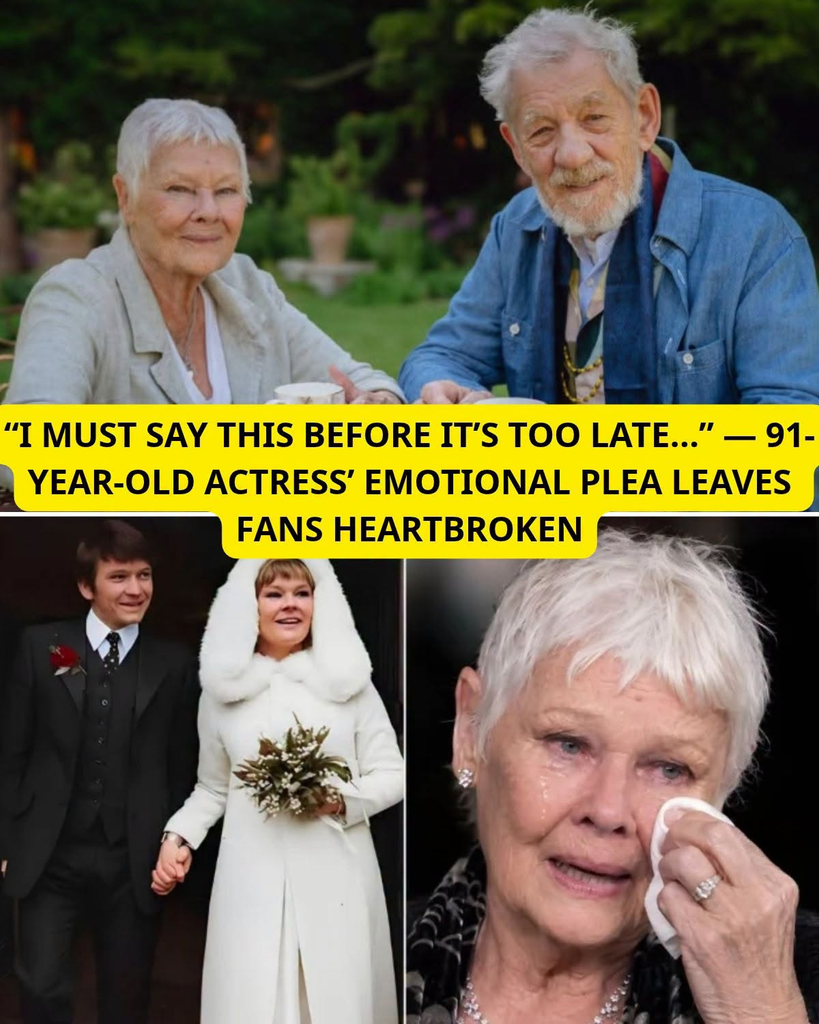
Dame Judi Dench has spent more than seven decades entertaining audiences with performances that have made her one of Britain’s most respected actors. From Shakespearean theatre to major Hollywood productions, her talent, wit, and distinctive presence have earned her admirers around the world.
Now, at 91, Dench has shared a difficult update about her deteriorating eyesight and the impact it has had on her everyday life. In a recent interview, she explained that her vision has worsened to the point that she can no longer perform on stage or in films, and reading has also become impossible for her.
Her comments offer a candid look at the challenges she faces while reflecting the extraordinary career that has defined so much of her life.
Judi Dench Shares a Difficult Update About Her Eyesight
On October 22, 2026, Dench spoke to Emma Barnett on BBC Radio 4’s Today programme about the progression of her vision problems.
She explained that her eyesight had reached a point where she could no longer act on stage, make films, or read. For an actor whose professional life has revolved around scripts, characters, and performance, these limitations represent a significant change.
Dench has lived with age-related macular degeneration for more than a decade. She first publicly discussed the condition in 2012, and she has spoken in previous interviews about how it has increasingly affected her work.
Her latest comments make clear how much more difficult everyday activities have become.
She also described struggling to recognize faces. During her interview, she explained that she sometimes approaches people believing she knows them, only to discover that she has mistaken a stranger for an acquaintance.
It is a personal difficulty that illustrates how vision loss can affect not only practical tasks but also ordinary social interactions.
[Source: Reuters reporting on Dench’s October 22 interview.]
What Is Age-Related Macular Degeneration?
Age-related macular degeneration, commonly known as AMD, is an eye condition that affects the macula, a part of the retina responsible for detailed central vision.
Central vision helps people perform tasks such as reading, recognizing faces, watching television, and seeing objects clearly when looking directly at them.
According to the UK’s National Health Service, AMD can make these activities increasingly difficult. The condition does not usually eliminate all vision, because peripheral vision may remain, but the effects on central vision can substantially change a person’s daily routine.
There are different forms of AMD, and the condition can progress at different rates.
Dench’s experience is her own and should not be taken to represent the exact symptoms or progression that everyone with AMD will experience. Nevertheless, her openness helps illustrate how a long-term eye condition can affect independence and quality of life.
Anyone experiencing changes in their vision should seek advice from an eye-care professional rather than assuming the symptoms are simply part of getting older.
[Source: NHS guidance on age-related macular degeneration.]
How Sight Loss Has Affected Her Acting Career
For Dench, acting has never been limited to appearing in front of a camera. Her career has involved learning dialogue, interpreting complex characters, performing live theatre, and collaborating closely with directors and fellow actors.
As her eyesight worsened, she adapted her working methods to continue performing.
In 2023, Dench explained that learning lines had become increasingly difficult. She had previously relied on her strong memory to learn dialogue, but the visual limitations associated with AMD made the process more challenging.
She subsequently relied on other people to help her learn scripts, including by reading dialogue aloud so she could memorize it.
These adjustments allowed her to continue working for a period despite the obstacles. Her latest interview, however, describes a more severe stage of sight loss that has left her unable to perform on stage or in films.
It is a significant development in the story of an actor whose career has lasted more than 70 years.
Rather than reducing her legacy to this latest health update, it is worth remembering the many performances and artistic achievements that established her reputation.
From Shakespearean Theatre to James Bond
Judi Dench built her reputation through years of work in theatre, television, and film.
She became especially celebrated for her Shakespearean performances, taking on demanding roles such as Juliet, Lady Macbeth, and Cleopatra. These productions showcased her ability to communicate complex emotions and bring classical characters to life.
Her success also extended to international cinema.
Many modern audiences recognize her as M, the formidable head of the British Secret Service in the James Bond films. Her portrayal brought authority, intelligence, and dry humor to the character, making her an important presence in the franchise.
Dench also received an Academy Award for her performance as Queen Elizabeth I in Shakespeare in Love.
Her achievements reflect a career that crossed generations and artistic boundaries. She earned recognition not simply for appearing in popular films but also for her ability to bring depth and precision to a wide range of roles.
That body of work remains a lasting part of her legacy.
Her Love of Shakespeare Remains Important
Despite the limitations imposed by her eyesight, Dench continues to speak passionately about the art that has shaped her life.
During her October interview, she expressed her enduring love for Shakespeare’s sonnets. She described their ability to capture human emotions through language and rhythm, emphasizing how powerfully they communicate feelings that people can recognize across different periods of history.
Her appreciation for the sonnets is particularly meaningful given the difficulties she now faces with reading.
Shakespeare’s poetry has been a significant part of Dench’s artistic world for decades. Her continued enthusiasm for the writing demonstrates that her connection to literature remains important, even as her ability to read has been affected by her condition.
It also offers a reminder that an artist’s relationship with their craft can extend beyond the practical demands of performing.
Learning to Adjust to a Different Way of Life
Dench has spoken frankly about the frustration of losing abilities that once seemed ordinary.
In her latest interview, she discussed the difficulty of no longer being able to see certain things clearly, including the bluebells that bloom in spring.
She explained that memories of familiar places and surroundings remain important to her, even when she can no longer see them as she once did.
Her comments reflect the emotional dimension of sight loss. Vision helps people navigate their surroundings, but it also shapes how they experience familiar places, recognize loved ones, and appreciate small details of everyday life.
Dench has acknowledged the difficulty of these changes while also describing the need to adapt.
She has not suggested that the experience is easy. Instead, her remarks convey a practical determination to adjust to circumstances she cannot simply wish away.
Her approach provides a personal example of resilience without diminishing the seriousness of her condition.
A Remarkable Legacy Beyond the Screen
Judi Dench’s latest health update has drawn attention because of the scale of her achievements and the affection many audiences feel for her work.
For generations of viewers, she has represented excellence in acting. Her performances have brought Shakespearean characters to life, helped define a memorable era of James Bond films, and earned recognition across the entertainment industry.
Her recent comments reveal the personal challenges behind that public legacy.
They also highlight why it is important to discuss aging and vision loss with accuracy and sensitivity. Dench’s experience should not be reduced to a sensational headline or an unsupported claim about a final message.
The verified story is already meaningful: a celebrated actor has spoken openly about a progressive eye condition and the profound changes it has brought to her professional and personal life.
At 91, her career stands as a testament to decades of dedication, while her willingness to discuss her circumstances offers audiences a more personal understanding of the woman behind the performances.
Frequently Asked Questions
1. How old is Judi Dench?
Judi Dench is 91 years old as of October 2026.
2. What eye condition does Judi Dench have?
Dench has age-related macular degeneration, a condition that affects central vision and can make reading and recognizing faces difficult.
3. Can Judi Dench still act in films or theatre?
In an interview on October 22, 2026, Dench said her eyesight had deteriorated to the point that she could no longer perform on stage or in films.
4. When was Judi Dench diagnosed with macular degeneration?
Dench publicly discussed her diagnosis in 2012. She has since spoken about the condition’s increasing effect on her work and daily life.
5. What are Judi Dench’s best-known roles?
Her best-known roles include M in the James Bond films and Queen Elizabeth I in Shakespeare in Love. She is also widely admired for her Shakespearean theatre performances.
Conclusion
Judi Dench’s latest interview provides a sobering update on the challenges she faces as her eyesight deteriorates. Her experience shows how a progressive eye condition can affect everyday activities and bring major changes to a long and successful career.
Yet the story of Judi Dench is much larger than her current health difficulties. Her decades of work in theatre and film have left a lasting mark on entertainment, and her love of Shakespeare’s language remains an important part of her identity.
Her latest remarks offer an opportunity to appreciate both her remarkable artistic legacy and the person navigating life beyond the spotlight.