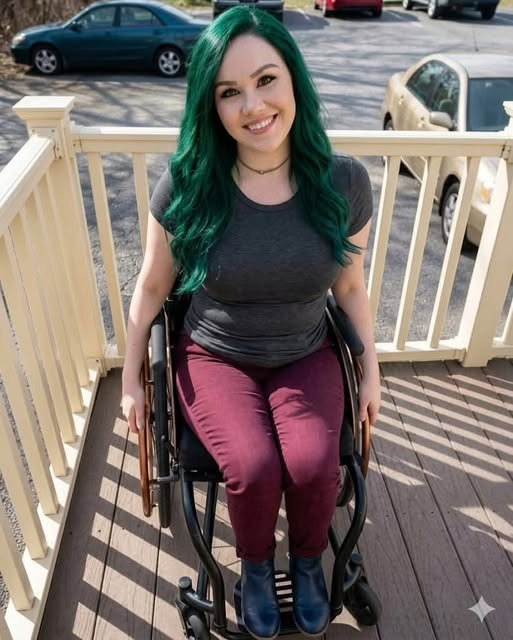
A photograph of a smiling woman sitting in a wheelchair on a sunny porch may seem like an ordinary moment. Yet images like this can encourage an important conversation about accessibility, independence, and the way people with disabilities are represented in everyday life.
The woman in the photograph has long green hair and a relaxed, friendly expression. She wears a gray T-shirt, burgundy trousers, and blue boots while sitting in a manual wheelchair. The setting looks residential, with a wooden deck, railings, and parked vehicles in the background.
Although the image does not tell us her name or personal story, it offers a useful starting point for exploring a subject that affects millions of people: creating environments where people with different mobility needs can participate in everyday activities with dignity and independence.
Why Everyday Representation Matters
Representation influences how people understand the world around them. Photographs, television programs, news stories, and social media posts all contribute to the way different groups are perceived.
When people with disabilities appear in ordinary settings, it helps present disability as part of everyday human experience rather than something that belongs exclusively in hospitals, rehabilitation centers, or medical discussions.
People with disabilities have diverse interests, personalities, relationships, ambitions, and lifestyles. A wheelchair does not reveal someone’s complete medical history, abilities, preferences, or personality.
That is why ordinary photographs can be valuable. They can encourage audiences to see the individual first instead of making assumptions based on a visible mobility aid.
Representation also matters because people should be able to recognize a broad range of human experiences in the media they consume. More balanced representation can challenge stereotypes and encourage more thoughtful conversations about inclusion.
However, representation should not depend on portraying someone as extraordinary simply because they have a disability. People deserve to be represented as individuals, with the same variety of experiences and everyday concerns as anyone else.
Understanding the Role of a Wheelchair
A wheelchair is a mobility device that helps a person move from place to place. For many users, it can support independence, participation, and access to activities that might otherwise be difficult or impossible.
People use wheelchairs for different reasons. Some have permanent mobility disabilities, while others experience temporary injuries or conditions that affect their ability to walk. Some people use wheelchairs throughout the day, while others use them only in particular situations.
The photograph does not reveal why the woman uses a wheelchair, and it would be inappropriate to guess.
It is also important to understand that a wheelchair does not automatically mean someone is unable to perform everyday tasks independently. People’s abilities and support needs vary considerably.
The most respectful approach is to avoid assumptions. If assistance is needed, offering help and allowing the person to decide whether to accept it is generally better than intervening without permission.
Language matters, too. The U.S. Centers for Disease Control and Prevention recommends respectful communication that emphasizes the person rather than reducing someone to a disability. The phrase “person who uses a wheelchair” is one example of this approach.
Accessibility Begins With Everyday Spaces
Independence depends on more than personal ability. The surrounding environment can either make everyday activities easier or create unnecessary obstacles.
Consider the wooden porch shown in the photograph. Railings, decking, and outdoor space are visible, but the image does not establish whether the home has an accessible entrance or whether the woman can independently enter and leave the property.
This distinction is important because an environment can look comfortable while still presenting accessibility challenges.
For someone who uses a wheelchair, a few steps at an entrance can prevent access. A narrow doorway, an uneven walkway, or a steep ramp can create similar difficulties.
Practical accessibility features can include:
- Step-free entrances and appropriately designed ramps.
- Doorways and hallways with sufficient clearance.
- Firm, stable, and slip-resistant walking or rolling surfaces.
- Accessible bathrooms and usable door handles.
- Adequate space to turn and maneuver a wheelchair.
- Accessible parking and connected routes to building entrances.
These features are not merely conveniences. They can affect whether someone can visit friends, attend appointments, enter a workplace, shop independently, or participate in community activities.
The U.S. Access Board publishes technical guidance explaining accessible routes and related design requirements under the Americans with Disabilities Act (ADA). Its guidance helps illustrate why access must be considered as part of an entire route rather than just a single doorway.
Disability Inclusion Is About More Than Ramps
Physical access is essential, but genuine inclusion involves more than construction and building design.
People with disabilities may also encounter communication barriers, negative assumptions, inflexible policies, inaccessible digital services, or social attitudes that limit participation.
For example, an event might take place in a building with a ramp but still be difficult to attend if the accessible restroom is unavailable. A public website may provide useful information but remain difficult to navigate with assistive technology.
Inclusion means identifying these barriers and working to remove them.
According to the CDC’s disability inclusion guidance, effective inclusion involves making environments, products, communication, and services more usable while supporting the participation of people with disabilities in everyday activities.
The goal is not simply to allow someone to enter a space. It is to make it possible for them to participate meaningfully once they arrive.
This principle applies to schools, workplaces, restaurants, parks, public transportation, healthcare facilities, and online communities.
How to Interact Respectfully With Wheelchair Users
Respectful behavior does not need to be complicated. Often, it begins with treating another person as an individual rather than making their mobility device the center of every interaction.
Ask before helping. If someone appears to be navigating a doorway or handling an object, ask whether they would like assistance. Do not assume that help is required.
Speak directly to the person. Address wheelchair users in the same natural way you would address anyone else. Avoid directing every question to a companion.
Respect personal space. A wheelchair is a mobility aid, and moving or touching it without permission can interfere with someone’s independence or comfort.
Avoid intrusive questions. A person’s medical history is private. Unless there is a relevant reason to ask, there is no need to question someone about why they use a wheelchair.
Use respectful language. Avoid expressions such as “confined to a wheelchair,” which can incorrectly suggest that the device only restricts a person’s life. Many people rely on wheelchairs to improve their mobility and independence.
Preferences about disability terminology can differ. Listening to how a person describes themselves is a useful way to show respect.
What Communities Can Do to Become More Inclusive
Creating accessible communities requires practical changes and a willingness to listen to people who experience barriers firsthand.
Local authorities can improve curb ramps, sidewalks, crossings, and public transportation access. Businesses can review entrances, aisles, restrooms, and customer service procedures. Employers and event organizers can consider accessibility before choosing locations or setting participation requirements.
Homeowners and property managers can also consider whether entrances, pathways, and essential rooms are usable by people with different mobility needs.
One particularly important step is involving people with disabilities in planning and decision-making. Their experiences can reveal problems that might otherwise go unnoticed.
Accessibility is often more effective when considered early in a project’s design than when added only after a problem becomes apparent.
These improvements can benefit more than wheelchair users. Smooth pathways, clear routes, and well-designed entrances may also help older adults, people recovering from injuries, parents using strollers, and people carrying heavy items.
Ultimately, accessibility is not a special favor. It is an important part of designing places and services that more people can use.
Frequently Asked Questions
1. Why is wheelchair accessibility important?
Wheelchair accessibility helps people navigate buildings, transportation systems, public spaces, and essential services. It can support independence, participation, and equal opportunities in daily life.
2. Does using a wheelchair always mean someone cannot walk?
No. Some people use wheelchairs because they cannot walk, while others can walk short distances or stand but need a wheelchair for longer journeys or specific circumstances. Individual needs vary.
3. What is the most respectful way to help a wheelchair user?
Ask whether assistance is wanted, listen to the person’s instructions, and respect their decision. Never assume that someone needs help simply because they use a wheelchair.
4. What makes a place accessible for wheelchair users?
Useful features can include step-free entrances, suitable ramps, wide enough doorways, accessible restrooms, stable surfaces, sufficient maneuvering space, and accessible routes between parking, sidewalks, and entrances.
5. How can people promote disability inclusion?
People can support accessible design, challenge unfair stereotypes, use respectful language, consider accessibility when organizing activities, and listen to people with disabilities about the barriers they encounter.
Conclusion: Making Inclusion Part of Everyday Life
The photograph of a smiling woman in a wheelchair does not tell us her personal history, and there is no need to invent one to recognize the value of the conversation it can inspire.
It reminds us that disability representation, accessibility, and respect are relevant to ordinary life. A welcoming community is not defined only by how it looks, but also by how easily different people can participate in it.
From accessible entrances and public transportation to considerate communication and inclusive attitudes, meaningful improvements often begin with recognizing barriers that others may overlook.
The broader goal is simple: build communities where people are treated with dignity, where access is considered from the beginning, and where everyone has a fair opportunity to participate.
Accessibility makes participation possible. Respect helps make inclusion real.