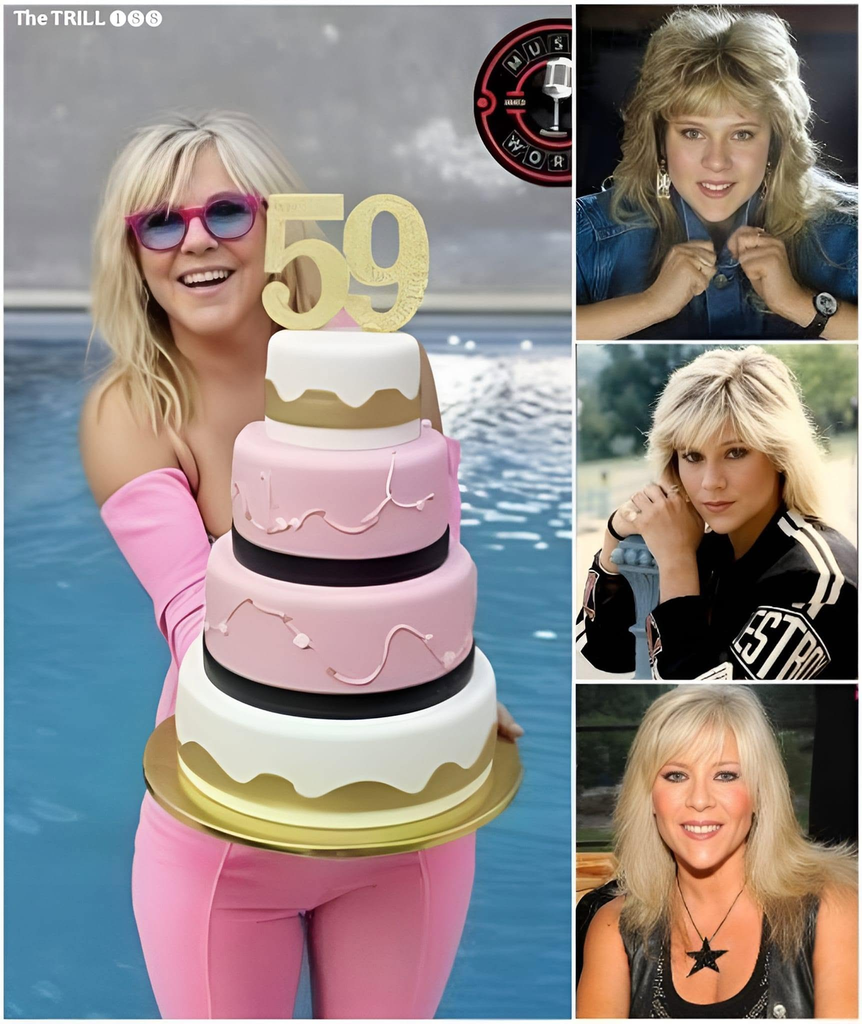
Birthdays offer a wonderful opportunity to celebrate life, revisit memories, and reflect on the years that have passed. Sometimes, a single photograph can capture that feeling through a combination of celebration and nostalgia. This image does exactly that, pairing a colorful birthday cake with three portraits that showcase different hairstyles, outfits, and photographic styles.
The main photograph features a woman holding a large, multi-tiered cake decorated in pink, white, black, and gold. A prominent number 59 stands above the cake, giving the celebration a milestone-birthday theme. Alongside the main image, three smaller portraits provide a visual contrast, inviting viewers to compare different looks and imagine the story connecting them.
Although the image resembles a celebrity birthday tribute, the woman’s identity and the dates of the individual portraits are not established by the picture alone. Nevertheless, it offers an interesting starting point for exploring birthday photography, personal style, nostalgia, and the importance of preserving memories accurately.
A Birthday Celebration That Stands Out
The centerpiece of the image is an elaborate tiered cake. Its combination of pink frosting, white decorative icing, dark bands, and gold accents creates a distinctive design.
The large number 59 is the most immediately noticeable detail. It establishes the intended birthday theme and gives the photograph a clear focal point.
The woman wears a bright pink outfit and colorful sunglasses, adding to the celebratory atmosphere. The outdoor setting, with a swimming pool visible in the background, provides a relaxed contrast to the carefully decorated cake.
Together, these elements create an image that feels festive rather than formal. The cake supplies the birthday symbolism, while the clothing and setting contribute to the photograph’s overall mood.
However, the number on a cake should not automatically be treated as independent proof of someone’s age. To establish that a person is actually celebrating a particular birthday, additional information from a reliable source would be needed.
Three Portraits, Three Different Looks
One of the most interesting features is the column of three smaller photographs beside the birthday image.
Each portrait presents a different combination of hairstyle, clothing, expression, and background. This arrangement encourages viewers to look beyond the birthday celebration and consider how personal style can change over time.
The first portrait
The upper photograph features blonde hair with considerable volume, a fringe, and a layered appearance. The subject wears a blue denim jacket and visible earrings.
The portrait has a more traditional studio-photography appearance than the main birthday photograph. Its darker background places the focus on the face and clothing.
The second portrait
The middle photograph presents another blonde hairstyle, with shorter-looking layers and a fuller fringe. The subject wears a black jacket with contrasting white stripes.
The pose is different, too. Rather than looking directly forward in the same manner as the other portraits, the subject rests her arms together in front of her.
These details give the image a distinct visual character without requiring assumptions about when or where it was taken.
The third portrait
The bottom photograph features long blonde hair with a fringe, a black sleeveless top, and a prominent star-shaped pendant.
Its warmer lighting and different background create another contrast with the other two portraits.
Taken together, the three images demonstrate how clothing, hairstyles, accessories, and photographic settings can produce noticeably different impressions.
The portraits may represent different periods, but their exact dates cannot be established from their appearance alone.
How Hairstyles and Fashion Shape a Photograph
A person’s hairstyle can strongly influence the overall impression of a portrait.
Changes in hair length, fringe, layering, and volume can alter the visual balance around the face. Clothing and accessories contribute additional details that help distinguish one look from another.
Fashion also reflects changing preferences and trends. Denim jackets, contrasting sportswear, statement jewelry, and different approaches to hairstyling can each evoke different visual associations.
However, it is important not to assign a specific year to a photograph simply because its fashion resembles a particular decade.
Styles frequently return, and older photographs may be edited or reproduced in ways that change their original appearance. Without a documented source, it is more accurate to describe what is visible than to claim that a portrait belongs to a specific year.
This distinction is especially important when photographs are shared online as celebrity retrospectives.
Why Then-and-Now Photography Remains Popular
Photographs can preserve moments that might otherwise be forgotten. A portrait taken years ago can provide a visual record of a particular hairstyle, outfit, setting, or stage of someone’s life.
Comparing several portraits makes those details easier to notice.
The format is also accessible. Readers do not need extensive background knowledge to recognize differences in hair, clothing, lighting, or composition.
Birthday photographs add another layer of interest because they connect the images to an occasion associated with personal milestones and reflection.
When a public figure’s identity and history are documented, a collection of portraits can also help illustrate a career spanning different periods. Such a retrospective is most informative when the photographs are dated accurately and accompanied by reliable biographical information.
Without that context, however, a visual comparison should remain just that: a comparison of the images presented.
What Should Readers Know About the Number 59?
The cake prominently displays the number 59, suggesting that the image was created to communicate a birthday celebration associated with that age.
But there are several reasons to verify the claim before publishing a detailed birthday article.
First, the image does not provide a confirmed name or birth date. Second, the date on which the photograph was taken is not shown. Third, the smaller portraits are not accompanied by captions identifying their dates or circumstances.
These missing details prevent an independent determination of the woman’s age or the timeline connecting the photographs.
If the image is intended to celebrate a public figure, the most useful next step is to consult a reliable biography, an official website, or a verified social media account.
Once the person’s identity is established, the birthday and age can be checked against documented information.
This process helps prevent inaccurate captions from being repeated across websites and social media pages.
How to Create a More Informative Birthday Retrospective
Anyone preparing a birthday tribute can make it more useful by combining appealing photographs with accurate information.
Start by confirming the person’s identity and the occasion being celebrated. Then, whenever possible, establish the original dates of the photographs through publication records, official captions, or other reliable documentation.
Next, provide context for the images. Explain where a photograph originally appeared or why it is relevant to the person’s life or work, provided those details can be verified.
Finally, distinguish confirmed facts from visual observations. A description of a hairstyle is directly supported by the photograph, while a claim about the person’s age or career requires additional evidence.
These simple steps help create a tribute that is both visually engaging and trustworthy.
Frequently Asked Questions
1. What is shown in the birthday photograph?
The main image shows a woman holding a large, multi-tiered birthday cake decorated in pink, white, black, and gold. The number 59 appears above the cake, while three additional portraits are arranged along the right side.
2. Who is the woman in the picture?
Her identity cannot be reliably established from the image alone. A verified name or an original source would be needed before publishing a factual biography.
3. Does the cake prove that she is 59 years old?
No. The number suggests the intended birthday theme, but it does not independently establish the subject’s age. Reliable biographical information would be needed to verify that claim.
4. Do the three smaller portraits show different years?
They show different hairstyles, outfits, and photographic presentations. They may come from different periods, but the exact dates cannot be confirmed from the image alone.
5. Why are birthday photo comparisons interesting?
They combine celebration with visual storytelling. Readers can notice changes in fashion, hairstyles, and photography while reflecting on how photographs preserve memories.
Conclusion
A birthday photograph can become more meaningful when it brings together a celebration and a collection of portraits. In this image, the colorful cake, the prominent number 59, and the three smaller photographs create a visual story about birthdays, personal style, and the passage of time.
The portraits offer plenty to observe, from hairstyles and clothing to lighting and composition. Yet the image also illustrates an important lesson: visual clues do not replace verified information.
Confirming the subject’s identity, age, and photographic timeline would make it possible to turn this visual comparison into a more detailed and reliable personal or celebrity retrospective.
Until those details are established, the image is best appreciated as a birthday-themed portrait collection that invites viewers to explore the relationship between photographs, style, and memory.