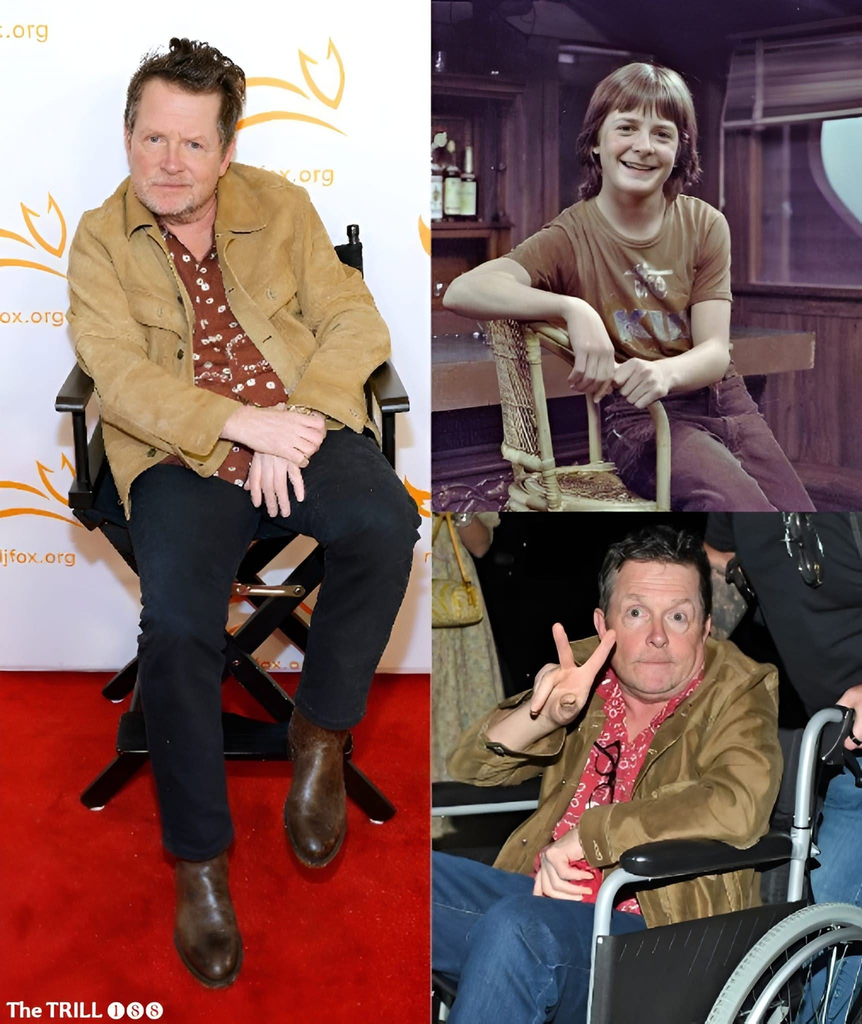
Michael J. Fox has spent decades entertaining audiences with memorable performances, sharp humor, and an unmistakable screen presence. Best known for playing Marty McFly in the Back to the Future trilogy and Alex P. Keaton in the television series Family Ties, he became one of the most recognizable actors of his generation. Yet his influence extends beyond Hollywood. His experience with Parkinson’s disease and his commitment to research have made him an important public figure in the search for better treatments.
A collection of photographs showing Fox at different stages of his life offers an opportunity to look beyond the familiar movie roles and explore the career, challenges, and advocacy that have shaped his public legacy.
How Michael J. Fox Became a Star
Michael Andrew Fox was born on June 9, 1961, in Edmonton, Alberta, Canada. He developed an interest in acting at a young age and began pursuing professional opportunities while still a teenager.
One of his early television roles came in the Canadian series Leo and Me. As his career developed, Fox moved to the United States to pursue greater opportunities in television and film.
His major breakthrough arrived in the early 1980s when he was cast as Alex P. Keaton in the NBC sitcom Family Ties. The character was a politically conservative, ambitious young man whose outlook often created humorous disagreements with his more liberal parents.
Fox’s energetic performance helped make the series a success. He received widespread recognition for his work, including three consecutive Primetime Emmy Awards for Outstanding Lead Actor in a Comedy Series from 1986 through 1988.
His ability to combine comedy, physical expression, and emotional sincerity became a defining feature of his acting style.
The Movie Role That Made Him an International Star
In 1985, Fox reached another career milestone when he starred as Marty McFly in Back to the Future, directed by Robert Zemeckis.
The science-fiction adventure followed a teenager who travels back to 1955 in a time machine built by the eccentric scientist Doc Brown, played by Christopher Lloyd. Marty must navigate the past and find a way to return to his own time.
The film became a major box-office success and developed into one of the most beloved movie franchises of its era. Fox returned as Marty in Back to the Future Part II in 1989 and Back to the Future Part III in 1990.
His portrayal of Marty combined humor, nervous energy, determination, and a relatable sense of vulnerability. These qualities helped make the character memorable across generations.
Fox also appeared in films such as Teen Wolf, The Secret of My Success, and Casualties of War. His work demonstrated that his talents extended beyond a single character or genre.
For many fans, however, Marty McFly remains the role most closely associated with his name.
A Parkinson’s Disease Diagnosis That Changed His Life
Behind his successful acting career, Fox was facing a personal challenge that few people knew about at the time.
He was diagnosed with young-onset Parkinson’s disease in 1991, when he was 29 years old. Parkinson’s is a progressive neurological disorder that affects movement and can also cause a range of non-motor symptoms. Tremor, stiffness, slowed movement, and balance difficulties are among its possible symptoms, although experiences vary from person to person.
Fox kept his diagnosis private for several years before publicly discussing it in 1998.
The announcement gave audiences a new understanding of the personal circumstances behind his life outside the screen. It also helped bring greater public attention to Parkinson’s disease, including the fact that it can affect younger adults.
A diagnosis does not produce the same experience for everyone, and Parkinson’s disease varies considerably between individuals. Fox’s experience is one person’s story, not a description of what every person with the condition will experience.
Despite the challenges associated with the disease, Fox continued acting. He appeared in television projects and made guest appearances in popular series, demonstrating that his professional life continued to evolve.
Building a Mission Around Parkinson’s Research
In 2000, Fox established the Michael J. Fox Foundation for Parkinson’s Research. The organization focuses on accelerating the development of better treatments and ultimately finding a cure for Parkinson’s disease.
The foundation supports scientific research, works with researchers and other stakeholders, and helps direct attention toward the needs of people living with the condition.
Its work reflects a significant shift in Fox’s public role. He remained an actor, but he also became a prominent advocate for research and a voice for people affected by Parkinson’s.
Research into Parkinson’s involves many different approaches, including studying the biology of the disease, identifying potential biomarkers, improving clinical trials, and developing treatments aimed at managing symptoms or changing the course of the condition.
Scientific progress requires careful testing and evidence. Although there is currently no universally established cure for Parkinson’s disease, research continues to investigate ways to improve diagnosis, treatment, and long-term outcomes.
Fox’s foundation has helped make Parkinson’s research a central part of his public legacy.
Family, Personal Life, and Continued Work
Fox married actress Tracy Pollan in 1988. The couple have four children and have generally maintained a relatively private family life despite Fox’s international fame.
His family has been part of his life beyond Hollywood, while his public advocacy has allowed him to discuss the importance of research and support for people living with Parkinson’s.
Fox has also continued to make selected appearances and take part in projects when possible. His later career includes guest roles in television productions and appearances that have reconnected him with audiences who first discovered him decades earlier.
In 2020, he published No Time Like the Future: An Optimist Considers Mortality, a memoir reflecting on aging, illness, family, and the ways his perspective has changed over time.
His writing provides another way for readers to understand his outlook, beyond the characters he has played.
Why Michael J. Fox’s Story Still Matters
The photographs of Fox at different stages of life highlight the passage of time, but his story cannot be reduced to a comparison between his younger and older appearances.
His legacy includes the television character who helped establish his career, the film franchise that made him internationally famous, and the advocacy work that has become central to his public life.
His openness about Parkinson’s has contributed to wider public awareness. His foundation has also helped connect scientific research with the experiences and priorities of people affected by the disease.
At the same time, it is important to recognize that Fox’s experience is personal. Parkinson’s affects people differently, and there is no single way to live with the diagnosis.
His journey offers a reminder that a person’s life can contain many chapters. Professional achievements, personal relationships, health challenges, and efforts to help others can all become part of a lasting legacy.
For longtime fans, Michael J. Fox will always be remembered for the humor and excitement he brought to the screen. For many others, his work supporting Parkinson’s research is an equally significant part of his contribution.
Frequently Asked Questions
1. How old is Michael J. Fox?
Michael J. Fox was born on June 9, 1961. His age depends on the current date.
2. What is Michael J. Fox best known for?
He is best known for playing Marty McFly in the Back to the Future trilogy and Alex P. Keaton in the television sitcom Family Ties.
3. When was Michael J. Fox diagnosed with Parkinson’s disease?
Fox was diagnosed in 1991 at age 29. He publicly disclosed his diagnosis in 1998.
4. What is the Michael J. Fox Foundation?
Founded in 2000, the Michael J. Fox Foundation for Parkinson’s Research is an organization dedicated to accelerating research toward better treatments and a cure for Parkinson’s disease.
5. Is there a cure for Parkinson’s disease?
There is currently no established cure for Parkinson’s disease. Treatments can help manage symptoms, and researchers continue to investigate improved therapies and ways to slow or prevent disease progression.
Conclusion
Michael J. Fox’s life brings together the lasting appeal of classic entertainment and a sustained commitment to scientific research. From Family Ties and Back to the Future to his work supporting Parkinson’s research, he has influenced audiences in more than one way.
His story is not simply about the challenges he has faced. It is also about a long acting career, family life, public service, and an effort to help improve the future for people affected by Parkinson’s disease.
For fans revisiting his early performances and readers discovering his advocacy for the first time, Fox’s legacy extends well beyond the screen.