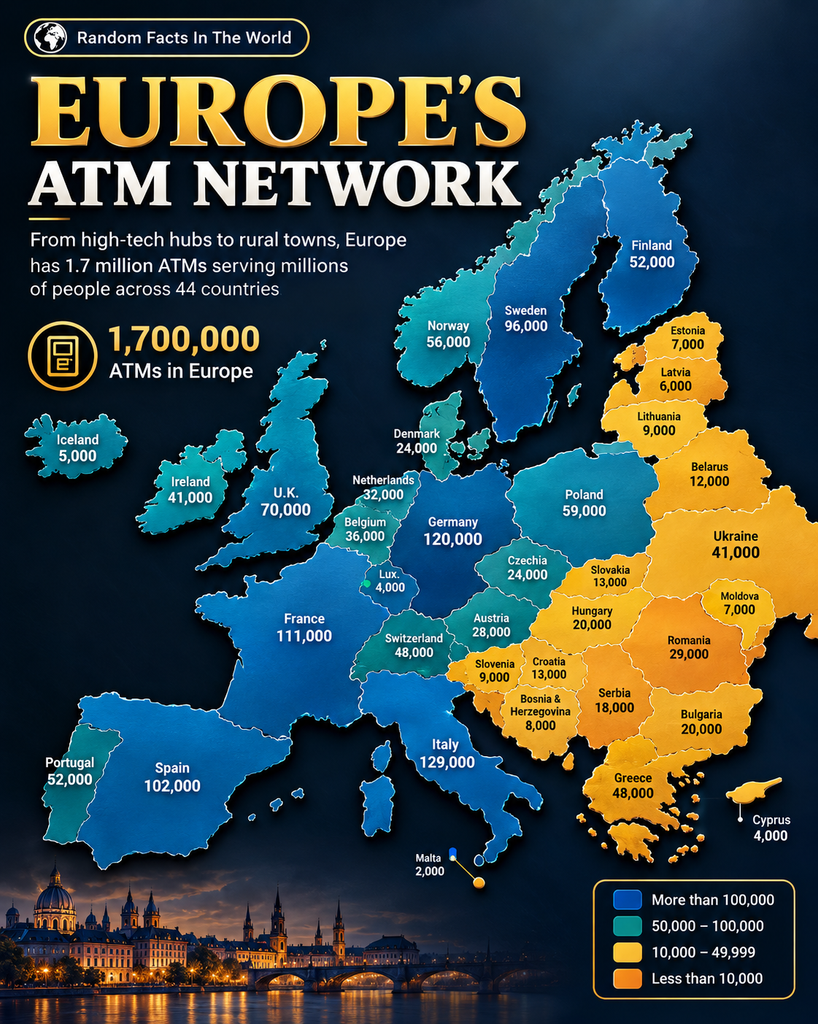
Europe’s relationship with cash is more diverse than many people realize. While some countries have historically maintained extensive networks of automated teller machines (ATMs), others have increasingly embraced digital payments and different ways of accessing money. A map comparing ATMs per 100,000 adults offers an intriguing snapshot of these differences.
The accompanying graphic displays country-level figures labeled 2019–2020, highlighting the uneven distribution of ATMs across Europe. But what do these numbers actually mean? Why might neighboring countries have different levels of ATM availability, and does having more machines necessarily make it easier to obtain cash?
Understanding the answers reveals a great deal about banking infrastructure, population patterns, consumer habits, and Europe’s changing financial landscape.
What Does the European ATM Map Measure?
The map measures the number of automated teller machines per 100,000 adults in each country. This is a population-adjusted indicator used in international financial-access statistics.
The World Bank publishes an indicator called “Automated teller machines (ATMs) (per 100,000 adults),” using data from the International Monetary Fund’s Financial Access Survey.
According to the World Bank’s methodology, the calculation divides the number of ATMs in a country by its adult population and multiplies the result by 100,000.
This makes comparisons between countries of different sizes more meaningful. A large country might have thousands of ATMs but a relatively low rate per adult, while a smaller country could have fewer machines overall but a higher rate.
Importantly, this indicator measures the density of ATMs relative to the adult population. It does not directly measure the distance to the nearest machine, the availability of cash at every location, withdrawal fees, or how frequently machines are used.
What Does the Map Reveal About Europe?
The graphic illustrates substantial differences in ATM density across the countries shown. Some displayed figures exceed 100 machines per 100,000 adults, while others fall below 60.
For example, the map labels Germany at 130, Austria at 168, France at 94, Spain at 103, Italy at 90, and the United Kingdom at 99. These are figures displayed in the graphic, not verified current values.
The differences are interesting because they demonstrate that European countries do not all maintain the same level of ATM infrastructure relative to their adult populations.
However, the map should be read as a historical comparison rather than a current league table. Its caption refers to 2019–2020, and the image does not provide a complete underlying data table or establish a separate reference year for every country. Readers should consult the original statistical series before using individual figures for formal comparisons.
The World Bank’s ATM indicator provides a way to investigate reported values by country and year.
Why Do ATM Numbers Differ Between Countries?
Several factors can influence how many ATMs a country has relative to its adult population.
1. Banking infrastructure and consumer demand
Countries develop their banking networks in response to local needs, historical practices, business models, and consumer preferences. Where people regularly withdraw cash, banks and independent operators may have stronger incentives to maintain convenient ATM networks.
In places where card payments and mobile banking are widely used, demand for cash withdrawals may be different. Nevertheless, digital payment adoption does not automatically mean that cash becomes unnecessary.
2. Population distribution
A country’s population is not evenly distributed across its territory. Large cities may contain many ATMs, while remote towns and rural communities have fewer options.
The World Bank specifically cautions that population-based measures of financial access assume a more uniform distribution of services than often exists in reality.
Consequently, a country can have a relatively high national ATM density while some residents still face long journeys to withdraw cash. Another country with fewer machines per adult might offer convenient access in densely populated areas.
3. Geography and settlement patterns
Mountainous regions, islands, sparsely populated areas, and isolated communities can make banking infrastructure more expensive to operate.
ATM operators must consider installation, maintenance, security, cash transportation, and the number of potential users at each location. These practical considerations can influence where machines are installed and whether they remain economically viable.
4. Banking competition and costs
Banks and independent ATM operators make decisions based on operating costs, customer demand, and the commercial value of particular locations.
The number of machines can also change when banks reorganize their branch networks or when cash-withdrawal services are provided through alternative arrangements. National totals alone cannot explain all these decisions.
Does a Higher ATM Density Mean Better Access to Cash?
Not necessarily.
ATM density is a useful starting point, but it is only one part of the picture. A more complete assessment would also consider geographical coverage, opening hours, withdrawal limits, transaction fees, machine reliability, and accessibility for people with disabilities.
Consider two hypothetical countries. Country A has many ATMs concentrated in its largest cities. Country B has fewer machines overall but distributes them strategically across towns and rural communities.
Country A could have the higher national density while some of its rural residents have worse access than people in Country B.
This distinction matters for travelers, older people, small businesses, and anyone who relies on cash for everyday purchases.
Is Europe Moving Away From Cash?
Europe has increasingly adopted electronic payments, but cash remains important.
The European Central Bank’s 2024 Study on the Payment Attitudes of Consumers in the Euro Area found that consumers were using non-cash payment methods more frequently and cash less often at points of sale than in earlier surveys. However, cash continued to be widely used, particularly for smaller payments.
The same study found that 62% of euro-area consumers considered it important or very important to retain cash as a payment option. It also reported that 87% found it fairly easy or very easy to reach an ATM or bank to obtain cash.
These results describe surveyed consumers in the euro area, not every country in Europe. They also measure reported experiences and attitudes rather than the exact number of ATMs.
The findings nevertheless demonstrate an important point: digital payments can grow without eliminating the need for cash infrastructure.
Cash can provide a payment alternative when electronic systems are unavailable, support people who prefer not to use digital services, and offer privacy in everyday transactions. Its importance varies by country and individual circumstances.
What Should Travelers Know About ATMs in Europe?
For visitors, the number of ATMs per adult is less useful than knowing where reliable machines are located and what withdrawing money will cost.
Before traveling, consider these practical steps:
- Check withdrawal fees. Your own bank and the ATM operator may each charge a fee.
- Understand currency conversion. When an ATM offers to charge your account in your home currency, compare the offered conversion with the alternative of being charged in the local currency.
- Plan for smaller towns. Do not assume that every rural destination or small island will have a convenient machine nearby.
- Carry a backup payment method. A second card or another payment option can be useful if a machine is unavailable or a transaction is declined.
- Keep some cash when appropriate. Local businesses, transport providers, and other services may have different payment preferences.
These precautions are useful regardless of whether a country’s national ATM density is high or low.
Frequently Asked Questions
1. What does ATM density per 100,000 adults mean?
It represents the number of ATMs in a country relative to its adult population. The measure helps compare countries of different sizes, but it does not indicate the exact number of machines available to an individual resident.
2. Which countries have the most ATMs in Europe?
The supplied map shows high figures for several countries, including Austria and Germany. However, the graphic’s figures are historical and have not all been independently verified. A reliable current ranking requires comparable data for the same year from an authoritative statistical source.
3. Does a high number of ATMs mean cash is more popular?
Not necessarily. ATM density reflects the number of machines relative to the adult population, not how often people use cash. Consumer payment preferences, access to electronic payments, and banking arrangements also influence cash use.
4. Is cash still important in Europe?
Yes. Electronic payments have become more common, but the European Central Bank’s 2024 research found that many euro-area consumers still considered retaining cash as a payment option important.
5. Where can I find official ATM statistics?
The World Bank’s Automated teller machines per 100,000 adults indicator provides country data based on the IMF Financial Access Survey. The underlying figures and reporting years should be checked before making current comparisons.
Conclusion: More Than Just Numbers on a Map
Europe’s ATM map offers a useful introduction to differences in financial infrastructure across the continent. It shows how the availability of cash machines, relative to adult populations, can vary considerably between countries.
Yet the most important lesson is that ATM density is not the same as convenient access to cash. Geography, settlement patterns, operating costs, banking practices, and consumer behavior all influence how easily people can obtain money.
As digital payments continue to evolve, the relationship between cash and electronic transactions will remain an important part of Europe’s financial story. Understanding the numbers—and their limitations—helps readers look beyond the map and see the wider picture.
Sources and further reading
- World Bank, Automated teller machines (ATMs) (per 100,000 adults): https://data.worldbank.org/indicator/FB.ATM.TOTL.P5
- World Bank, Indicator methodology and limitations: https://databank.worldbank.org/metadataglossary/world-development-indicators/series/FB.ATM.TOTL.P5
- European Central Bank, Study on the payment attitudes of consumers in the euro area (SPACE) – 2024: https://www.ecb.europa.eu/stats/ecb_surveys/space/html/ecb.space2024~19d46f0f17.en.html