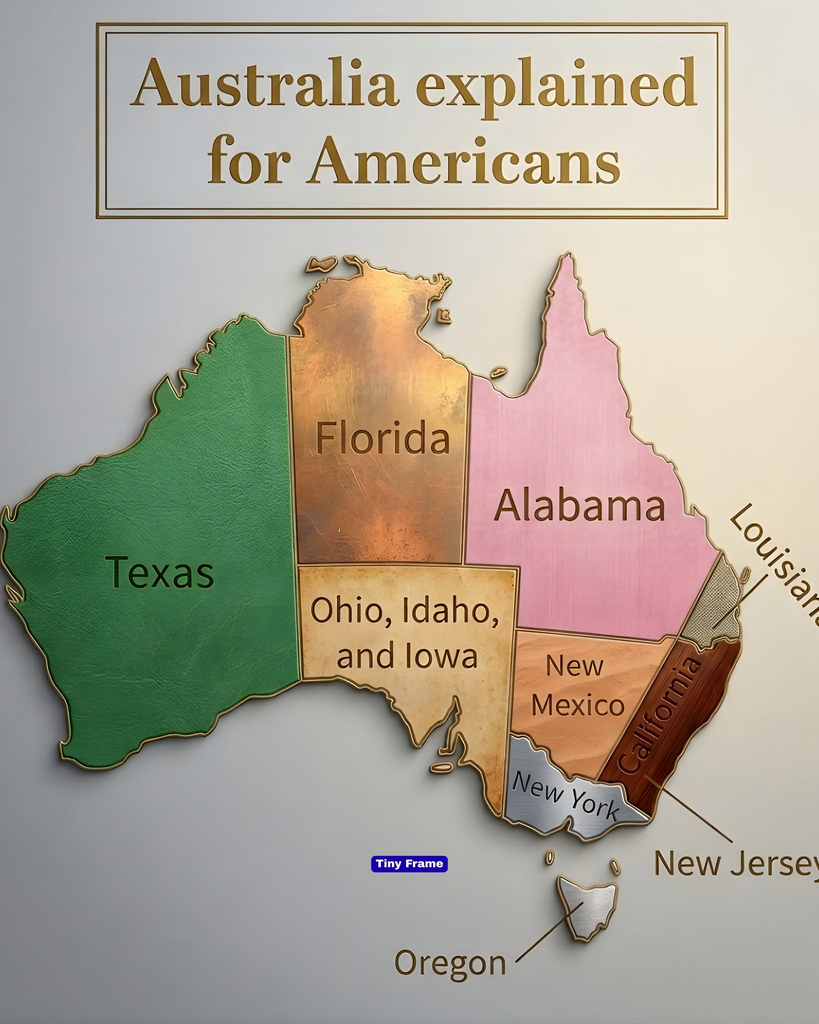
When Americans look at a map of Australia, they often see a huge country surrounded by ocean. But understanding its actual size, geography, and population becomes much easier when comparing it with something familiar: the United States.
Australia is so large that its total area is almost equal to that of the contiguous 48 American states. Its individual states are also enormous, with Western Australia alone covering an area more than three times the size of Texas.
But size is only one part of the story. Australia has different climates, enormous deserts, modern coastal cities, tropical rainforests, and some of the world’s most unusual natural landscapes.
Let’s explore Australia through comparisons that make sense to Americans.
1. Australia Is Almost as Large as the Lower 48 States
One of the biggest surprises about Australia is its total land area.
Australia covers approximately 7.69 million square kilometers, or 2.97 million square miles. That makes it the world’s sixth-largest country by total area.
For comparison, the contiguous United States covers approximately 8.08 million square kilometers. This means Australia is roughly 95% of the size of the lower 48 states combined.
In other words, you could place nearly the entire Australian continent alongside the continental United States in a geographical size comparison.
However, Australia is not as large as the entire United States when Alaska and Hawaii are included.
This is an important distinction because many maps make geographical comparisons look different depending on their projection and scale.
Source: Geoscience Australia – Australia’s Size Compared.
2. Australia Has Six States and Two Main Mainland Territories
Unlike the United States, which has 50 states, Australia has six states and two main mainland territories.
These are:
- Western Australia: The largest state, covering approximately 2.53 million square kilometers.
- Queensland: Known for tropical coastlines, the Great Barrier Reef, and Brisbane.
- South Australia: Home to Adelaide, wine regions, and large areas of dry inland country.
- New South Wales: Includes Sydney, Australia’s largest city.
- Victoria: A smaller southeastern state known for Melbourne and its cultural attractions.
- Tasmania: An island state south of mainland Australia, famous for its wilderness and natural scenery.
- Northern Territory: A vast territory containing Darwin, Alice Springs, and Uluru.
- Australian Capital Territory: A small territory containing Canberra, the national capital.
The Australian Capital Territory is particularly interesting because it serves a role somewhat comparable to Washington, D.C., although their political and constitutional arrangements are different.
These are Australia’s actual administrative divisions. The American state names shown in the uploaded graphic should not be confused with official Australian boundaries.
Source: Australian Bureau of Statistics – Australia and State/Territory.
3. Western Australia Is Bigger Than Many Countries
Western Australia is an especially impressive example of Australia’s enormous geography.
It covers approximately 2.53 million square kilometers.
To put that into perspective, Texas covers approximately 696,000 square kilometers. Western Australia is therefore about 3.6 times the size of Texas.
California, another familiar American reference, covers approximately 424,000 square kilometers. Western Australia is almost six times larger.
Yet much of Western Australia is sparsely populated.
Its landscape includes deserts, remote mining communities, rugged coastlines, forests, and some of Australia’s most spectacular natural attractions.
Perth, the state capital, is one of the country’s major coastal cities, but enormous distances separate it from many other Australian population centers.
This is one reason why driving across Australia can be a much bigger undertaking than many visitors expect.
4. Australia’s Population Is Surprisingly Small for Its Size
Here is another major difference between Australia and America.
Australia has a huge geographical area, but its population is relatively small.
According to the Australian Bureau of Statistics, the country’s population reached approximately 27.9 million people on March 31, 2026.
That is a relatively small population for a country covering nearly 7.7 million square kilometers.
Much of Australia’s interior is dry, remote, and sparsely populated. As a result, most Australians live in cities and communities along the coastal regions.
The largest population centers include:
- Sydney
- Melbourne
- Brisbane
- Perth
- Adelaide
- Canberra
For Americans, this means Australia can feel very different from the United States. Large metropolitan areas are separated by enormous stretches of countryside, desert, and open land.
Source: Australian Bureau of Statistics – National, State and Territory Population.
5. Australia’s Climate Changes Dramatically Across the Country
Australia is often associated with sunshine, beaches, and warm weather, but its climate is much more diverse.
The northern parts of the country experience tropical conditions, with wet and dry seasons.
Central Australia contains vast desert regions, where temperatures can become extremely high during summer and nights can become surprisingly cold.
The southeastern areas experience more temperate conditions, with cooler winters and seasonal rainfall.
Tasmania, located south of the mainland, generally has a cooler climate than much of the country.
This variety means that traveling from one part of Australia to another can feel like visiting completely different environments.
Americans familiar with the climate differences between Florida, Texas, California, and Alaska may find this comparison helpful.
However, Australia’s seasons are reversed compared with those in the Northern Hemisphere.
When it is summer in the United States, it is generally winter in Australia.
6. Australia’s Major Cities Are Farther Apart Than Many Visitors Expect
Another important geographical difference is the distance between Australia’s major cities.
For example:
- Sydney and Melbourne are approximately 700–900 kilometers apart by road, depending on the route.
- Melbourne and Adelaide are approximately 730 kilometers apart by road.
- Sydney and Brisbane are approximately 900 kilometers apart by road.
- Perth is thousands of kilometers away from Australia’s eastern metropolitan centers.
These distances explain why domestic flights are popular for traveling between major Australian cities.
A visitor should not assume that seeing Sydney, Melbourne, Brisbane, and Perth can easily fit into a short road trip.
Australia’s enormous size requires careful travel planning.
7. Australia Has Landscapes Found Nowhere Else
Australia is not just about big cities and long highways.
It is home to some remarkable natural landmarks.
The Great Barrier Reef, located off Queensland’s coast, is the world’s largest coral reef ecosystem.
Uluru, in the Northern Territory, is one of Australia’s most recognizable natural landmarks and holds deep cultural significance for Aboriginal people.
The Australian Outback includes huge areas of remote inland country, while Tasmania contains forests, mountains, and protected wilderness areas.
Australia also has distinctive wildlife, including kangaroos, koalas, wombats, and platypuses.
These natural features help explain why Australia attracts visitors from around the world.
Frequently Asked Questions
1. Is Australia bigger than the United States?
Australia is not bigger than the entire United States. However, it is approximately 95% of the area of the contiguous 48 states, making the comparison surprisingly close.
2. How many American states would fit inside Australia?
It depends on which states are selected. Australia covers approximately 11 times the area of Texas, or around 18 times the area of California.
3. What is Australia’s largest state?
Western Australia is the largest Australian state, covering approximately 2.53 million square kilometers.
4. Why does Australia have such a small population?
Large areas of the country are desert or semi-arid environments with limited water and settlement. Most Australians live in coastal cities and surrounding regions.
5. What is Australia’s capital city?
Canberra is Australia’s capital. Sydney and Melbourne are larger and more internationally recognized cities, but neither is the national capital.
Conclusion: Australia Is a Continent-Sized Country With a Unique Geography
Australia is much more than a large island on a world map.
Its geographical area is almost comparable to that of the contiguous United States, yet its population is relatively small and concentrated in coastal cities.
Its six states and two main mainland territories contain everything from tropical coastlines and enormous deserts to cool forests and modern metropolitan areas.
For Americans, comparing Australia with familiar US states is a useful way to understand its scale. But the real geography is even more interesting than any simplified map can show.