Today, Morgan Freeman is recognized around the world for his remarkable acting career, calm screen presence, and unmistakable voice. But before he became one of the most respected figures in American cinema, he was a young man exploring a very different future.
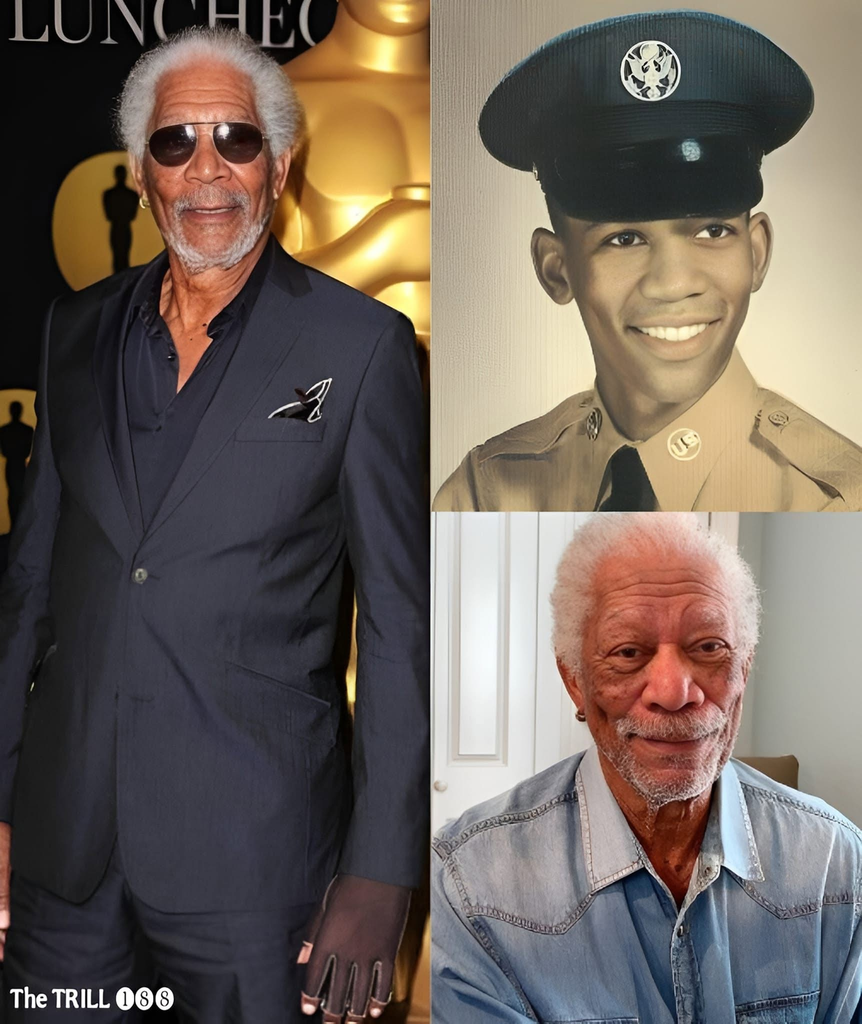
A collage showing Freeman in military uniform, dressed for a formal event, and in later life captures three distinct looks across the years. The photographs offer a visual reminder of the passage of time, but his real story is even more interesting: Freeman served in the United States Air Force, pursued acting for decades, and achieved major film recognition later than many performers.
His journey demonstrates that a successful career does not always follow a straight line—and that early ambitions can change as life unfolds.
A Young Morgan Freeman Before Hollywood
Morgan Freeman was born on June 1, 1937, in Memphis, Tennessee. He developed an interest in acting while he was still a student and participated in school performances.
According to the American Film Institute, Freeman won a statewide acting competition at age 12. That early recognition suggested an aptitude for performance, although his professional future was far from certain.
After graduating from high school in 1955, Freeman faced an important decision. Rather than accept a drama scholarship to Jackson State University, he chose to enlist in the U.S. Air Force.
This decision led him into a chapter of life that is less familiar to some movie fans than his celebrated screen roles.
Morgan Freeman’s Years in the U.S. Air Force
The young man pictured in military uniform represents an important part of Freeman’s documented biography.
Freeman served in the U.S. Air Force from 1955 to 1959. The U.S. Department of Defense reports that he trained as an automatic tracking radar repairman. He eventually left the military with the rank of airman first class.
His original interest in aviation had included the ambition to become a pilot. However, military life helped him recognize that the career he had imagined was not necessarily the future he wanted.
After receiving an honorable discharge in 1959, Freeman returned to his interest in performance and began pursuing acting more seriously.
Source: U.S. Department of Defense — Actor Morgan Freeman Was Air Force Radar Repairman.
Building an Acting Career One Step at a Time
Freeman’s path to Hollywood recognition was not immediate. After his military service, he studied acting and theater, including at the Pasadena Playhouse and Los Angeles City College. He later spent time in New York, where he continued seeking performance opportunities.
His career developed through theater and television rather than through instant movie stardom.
In 1967, Freeman made his Broadway debut in an all-Black production of Hello, Dolly! starring Pearl Bailey. He subsequently gained wider exposure through stage performances and television appearances.
One particularly memorable television role came on the educational children’s program The Electric Company, where he played Easy Reader during the 1970s. The series introduced him to audiences who might not yet have associated his name with major motion pictures.
These early jobs were important steps in a career that would eventually span theater, television, film, and narration.
The Breakthrough That Came Later in Life
One of the most compelling aspects of Freeman’s story is that his biggest film breakthrough did not arrive in his twenties.
In 1987, at approximately 50 years old, he earned widespread attention for his performance in Street Smart. The role brought him an Academy Award nomination for Best Supporting Actor and helped establish him as a major screen talent.
He subsequently appeared in films that became important milestones in American cinema.
Memorable films that helped define his career
- Driving Miss Daisy (1989): Freeman played Hoke Colburn in the film adaptation of Alfred Uhry’s play. His performance earned major recognition, including a Golden Globe Award.
- The Shawshank Redemption (1994): His portrayal of Ellis Boyd “Red” Redding became one of his best-known performances.
- Se7en (1995): Freeman played Detective William Somerset in the crime thriller.
- Million Dollar Baby (2004): His performance as Eddie “Scrap-Iron” Dupris earned him the Academy Award for Best Supporting Actor.
- Invictus (2009): Freeman portrayed Nelson Mandela in the film about South Africa’s 1995 Rugby World Cup and the country’s post-apartheid transition.
These roles demonstrate his versatility, from thoughtful dramatic performances to crime thrillers and historical stories.
The Academy Award for Million Dollar Baby was a particularly important milestone. It recognized a performer whose career had developed over many years rather than through a sudden rise to fame.
The Famous Voice and Lasting Screen Presence
Freeman’s career is not defined by acting alone. His distinctive voice has made him a sought-after narrator for documentaries, films, and other productions.
His measured delivery and clear articulation can lend a sense of authority and warmth to a story. That quality has become so closely associated with him that his voice is now an important part of his public identity.
Nevertheless, his success cannot be reduced to narration. His performances across multiple genres have helped build a body of work spanning several decades.
The photographs in the collage offer a visual contrast between his early years and his later public image. His white hair and beard have become familiar features, while his formal appearances often reflect the polished style associated with major entertainment events.
The exact dates of the photographs are not established by the collage, but their contrasting presentation makes the passage of time easy to appreciate.
What Morgan Freeman’s Journey Teaches Us
Freeman’s career is a useful reminder that there is no universal timetable for success.
He showed an interest in acting as a child, served in the military as a young adult, and spent years developing his skills before achieving a major film breakthrough. His experience challenges the idea that everyone must establish a successful career early in life.
It also illustrates the value of persistence. Theater, educational television, supporting roles, and film performances all contributed to his development as an actor.
His story does not mean that every long pursuit will end in fame. Rather, it demonstrates that skills can grow over time and that a person’s early career choices do not necessarily determine their entire future.
Frequently Asked Questions
1. Did Morgan Freeman serve in the military?
Yes. Freeman served in the U.S. Air Force from 1955 to 1959 and was discharged as an airman first class.
2. How old was Morgan Freeman when he became widely recognized in film?
His breakthrough performance in Street Smart came in 1987, when he was approximately 50 years old. He had already accumulated years of experience in theater and television.
3. What was Morgan Freeman’s first major television role?
One of his best-known early television roles was Easy Reader on the educational children’s program The Electric Company, which he appeared in during the 1970s.
4. Which movie earned Morgan Freeman an Academy Award?
He won the Academy Award for Best Supporting Actor for his performance in Million Dollar Baby at the 77th Academy Awards in 2005.
5. Why is Morgan Freeman’s career considered unusual?
His major film recognition arrived relatively late compared with that of many actors. His long development through theater, television, and supporting roles illustrates how an acting career can build gradually over decades.
Conclusion
The photographs of Morgan Freeman—from his early military years to his familiar later-life appearance—show different stages of a long and remarkable journey.
Behind the recognizable face and celebrated voice is a story of changing ambitions, military service, years of acting work, and major recognition that came later in life. His performances in films such as Driving Miss Daisy, The Shawshank Redemption, and Million Dollar Baby helped establish a legacy that reaches across generations.
For audiences who know Freeman mainly from his most famous roles, the military portrait offers a reminder that his life included important chapters long before Hollywood fame.
His journey stands as an example of how a career can develop over time—and why the story behind a familiar face can be just as interesting as the photographs themselves.