Family stories often begin with something small: a passing comment, an unexpected purchase, or a relative who seems determined to have the last word. Sometimes, the result is an argument. Other times, it becomes the kind of funny story people share online because it feels strangely familiar.
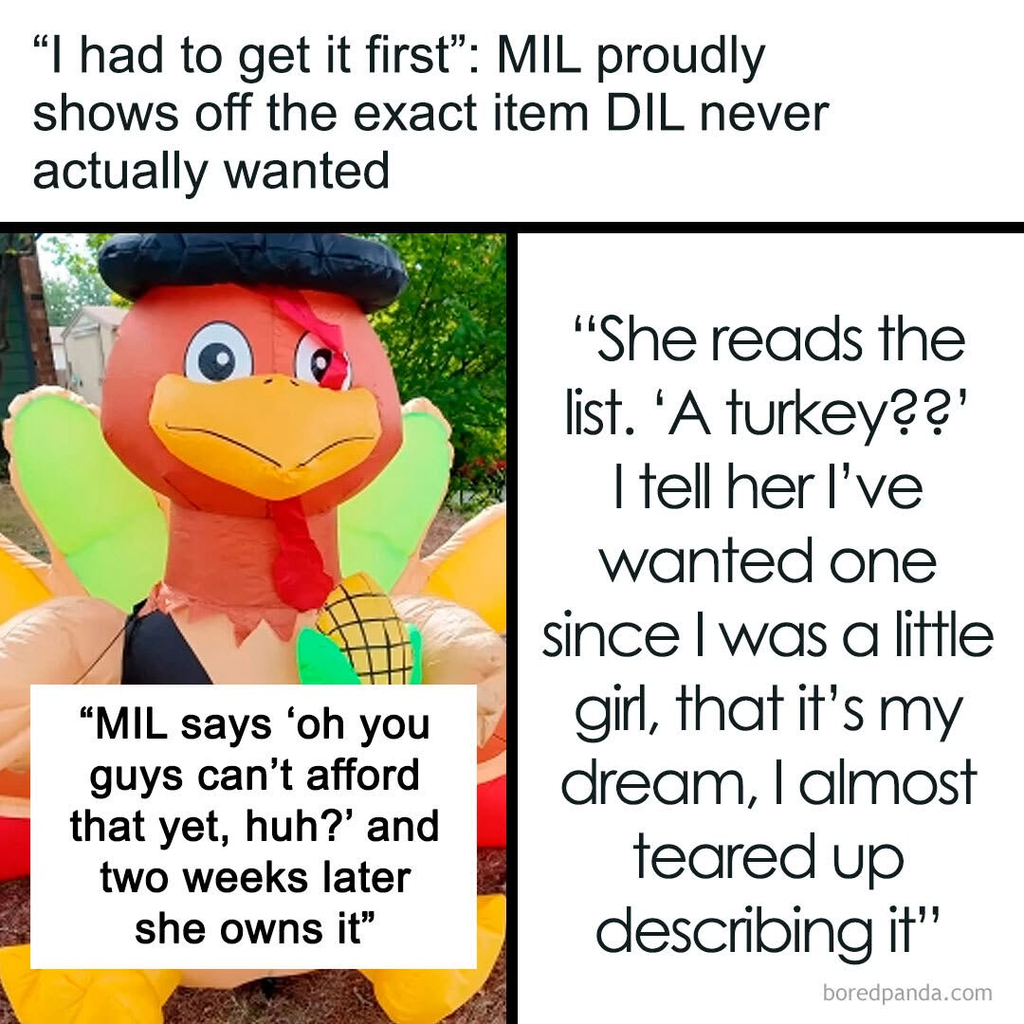
A popular family-humor meme featuring a mother-in-law, a daughter-in-law, and an enormous inflatable turkey captures exactly that kind of situation. The headline suggests that the mother-in-law proudly bought an item her daughter-in-law never actually wanted. The accompanying story adds another layer of irony, turning an ordinary holiday decoration into the center of a memorable family joke.
It is funny because the situation is so recognizable: sometimes, the most entertaining family moments are not really about the thing being purchased. They are about what people say, what they think other people mean, and how everyone reacts afterward.
The Inflatable Turkey That Started the Joke
The meme features a giant, colorful inflatable turkey wearing a dark hat. The decoration is large enough to attract attention in a yard, making it an amusing centerpiece for the story.
According to the text presented in the meme, the mother-in-law once made a teasing remark suggesting that the younger couple could not afford the item yet. Two weeks later, she owned it herself.
The second part of the meme adds a humorous twist. The daughter-in-law supposedly reads the list, sees the turkey, and claims that she has wanted one since childhood. She describes it as her dream purchase and says she nearly became emotional while explaining it.
The humor comes from the contrast between the dramatic description and the rather ordinary object at the center of the story.
An inflatable turkey is not usually considered a lifelong dream. That is precisely why the exaggerated reaction works as a joke.
The image does not establish whether the exchange happened exactly as described. Instead, it presents a comedic scenario that plays on familiar family relationships and playful exaggeration.
Why Mother-in-Law and Daughter-in-Law Jokes Are So Popular
Mother-in-law and daughter-in-law relationships have long been a source of jokes, television storylines, and internet memes.
Part of the reason is that these relationships can bring together people with different habits, expectations, traditions, and ideas about family life. One person may see a comment as harmless teasing, while another may interpret it as criticism or an attempt to compete.
Purchases can make these differences particularly noticeable.
A new decoration, a kitchen appliance, an outfit, or an expensive gift might seem insignificant to one person. To another, it could represent personal taste, financial independence, or a desire to be recognized.
In a humorous meme, these differences are exaggerated to create a simple punchline.
However, real families are more complicated than internet stereotypes suggest. Many mothers-in-law and daughters-in-law have warm, supportive relationships. The same joke that makes one person laugh might feel uncomfortable to someone who has experienced genuine tension with relatives.
The best family humor allows people to laugh at an awkward situation without assuming that every relationship follows the same pattern.
When a Simple Purchase Becomes a Competition
One of the most relatable elements of the meme is the suggestion of competition.
Imagine mentioning something you like, only to have a relative respond with a comment about whether you can afford it. Later, that relative buys the same thing.
Depending on the circumstances, the situation might feel amusing, confusing, or irritating. Was the original comment simply a joke? Did the person genuinely want the item? Was the purchase completely unrelated to the earlier conversation?
Without knowing someone’s intentions, it is easy to invent a story around a small event.
That uncertainty is part of what makes the meme effective. Readers can imagine several possible explanations, each leading to a different interpretation of the same situation.
Perhaps the mother-in-law genuinely likes the decoration. Perhaps she enjoys teasing her relatives. Or perhaps the entire scenario is simply an exaggerated fictional story created for entertainment.
The picture does not provide enough evidence to decide between those possibilities.
That is also a useful lesson for everyday relationships: a single purchase or comment rarely tells the whole story.
The Comedy of Pretending an Inflatable Turkey Is a Lifelong Dream
The second part of the meme takes the humor even further.
Rather than openly complaining about the situation, the daughter-in-law supposedly responds by describing the turkey as something she has wanted since childhood.
This is an example of comedic exaggeration. The character treats an oversized holiday decoration as though it were a deeply meaningful personal ambition.
The contrast between the object and the emotional response creates the punchline.
It also gives readers room to imagine the scene. Someone reads the list, pauses at the turkey, and suddenly delivers a heartfelt speech about a childhood dream that may never have existed.
That kind of playful storytelling is common in memes because it takes an ordinary object and gives it an absurdly important role.
The joke does not require an elaborate explanation. Readers understand the humor immediately because the emotional reaction is so disproportionate to the purchase.
How Social Media Turns Family Moments Into Viral-Style Humor
Family memes work well on social platforms because they combine a recognizable situation with a short, easy-to-understand punchline.
A picture can communicate the basic setup in seconds. The headline introduces the conflict, while the accompanying text provides the twist.
Readers may respond by tagging relatives, sharing similar experiences, or adding their own humorous interpretations in the comments.
An inflatable turkey is especially suited to this format because it is visually unusual. Its size, bright colors, and exaggerated design make it an effective image for a story about questionable priorities and family competition.
Still, a meme’s popularity does not prove that its story is true or that it represents every family. Social media content often uses invented dialogue, exaggerated scenarios, or fictional characters to create humor.
It is best to enjoy the joke for what it offers: a funny take on the way people sometimes turn small differences into entertaining stories.
How to Handle Similar Situations in Real Life
Although the meme is lighthearted, the situation it describes can resemble real family disagreements.
If a relative makes a remark that feels competitive or dismissive, it can help to consider the context before reacting. A playful comment between people who enjoy teasing each other may not require a serious response.
If the comments repeatedly feel disrespectful, however, calmly expressing how they affect you can be more useful than responding with another insult.
A few simple approaches can help:
- Avoid assuming intentions. A purchase or remark may have several explanations.
- Keep small disagreements in perspective. Not every difference in taste needs to become a competition.
- Use humor when everyone is comfortable with it. A shared joke can make an awkward moment easier.
- Set boundaries when necessary. Repeated personal criticism deserves a respectful conversation.
- Remember that every family is different. One funny story should not define an entire relationship.
These suggestions do not mean people must ignore genuine problems. They simply encourage a response that matches the seriousness of the situation.
Frequently Asked Questions
1. What is the inflatable turkey meme about?
It portrays a humorous scenario involving a mother-in-law who buys a giant inflatable turkey after making a teasing remark about affordability. The daughter-in-law’s exaggerated reaction supplies the punchline.
2. Is the story about the mother-in-law verified?
The image alone does not establish that the events happened to a real family. It should be treated as a humorous anecdote presented in a meme, not as a verified personal account.
3. Why are mother-in-law memes so common?
They often draw on recognizable family dynamics, differences in expectations, playful teasing, and misunderstandings. However, real relationships vary widely, and many in-law relationships are positive.
4. Why is the turkey decoration funny?
The decoration is oversized and visually unusual, while the story treats it as a supposedly lifelong dream. The contrast between the ordinary purchase and the exaggerated emotional response creates the joke.
5. How can families avoid unnecessary arguments over small things?
Clear communication, avoiding assumptions, and keeping minor disagreements in perspective can help. When a comment becomes repeatedly hurtful, a calm conversation about boundaries may be appropriate.
Conclusion: Sometimes the Smallest Things Make the Biggest Stories
The inflatable turkey meme turns a simple holiday decoration into a playful story about family competition, teasing, and exaggerated reactions.
Its appeal comes from the contrast between the mother-in-law’s apparent purchase and the daughter-in-law’s dramatic claim that the turkey has always been her dream. Whether readers laugh at the awkwardness, the oversized decoration, or the unexpected punchline, the situation is easy to imagine.
Real family relationships are more nuanced than a meme can show, but humor can offer a harmless way to recognize life’s occasional absurdities.
And if nothing else, the story proves that even a giant inflatable turkey can become the star of a family joke.