Few R&B groups have left a cultural footprint quite like Destiny’s Child. Known for powerful vocals, memorable harmonies, confident performances, and distinctive fashion, the group became one of the defining acts of late-1990s and early-2000s popular music.
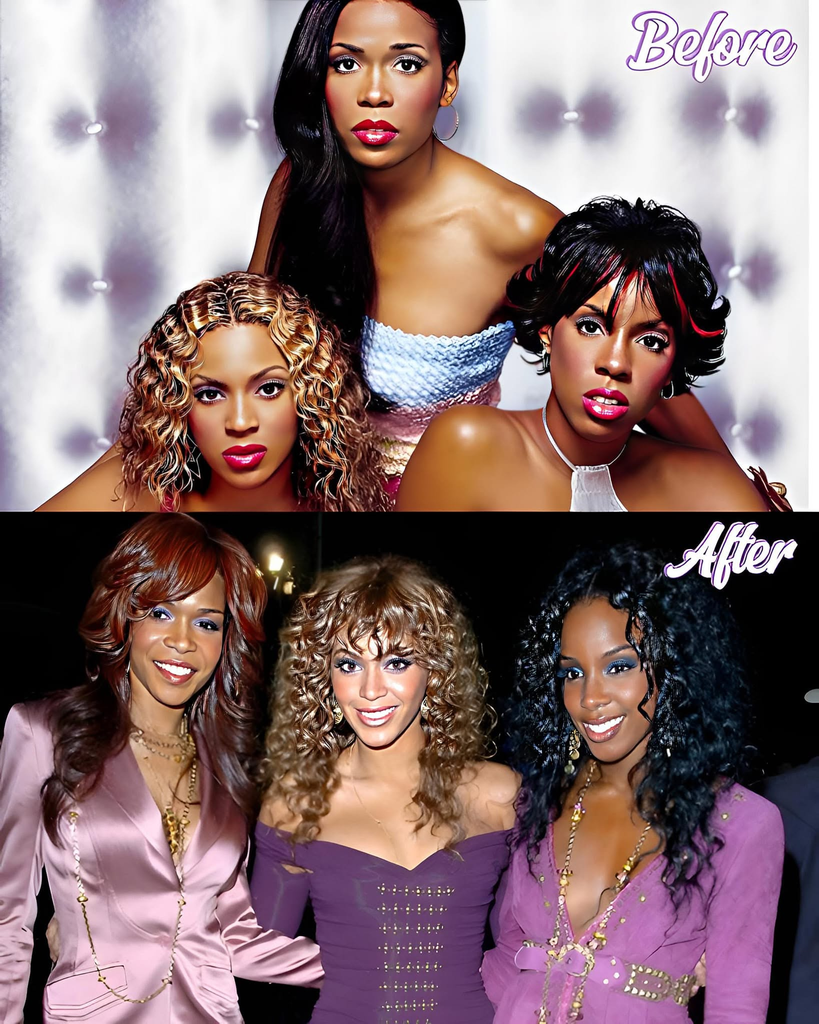
A side-by-side collage labeled “Before” and “After” invites viewers to look back at the group’s changing appearance. Although the exact identities and dates in the uploaded image cannot be independently verified, it provides a useful starting point for exploring Destiny’s Child’s history, changing lineup, and lasting influence on music and fashion.
How Destiny’s Child Began
The story began in Houston, Texas, in the early 1990s. Beyoncé Knowles and LaTavia Roberson met while auditioning for a young performers’ group. Kelly Rowland joined the developing act, which performed under the name Girl’s Tyme before eventually becoming Destiny’s Child.
LeToya Luckett later joined, forming the quartet that signed with Columbia Records under the Destiny’s Child name. The group released its debut album in 1998, helping establish its place in contemporary R&B. Its early success came after years of rehearsals, local performances, and efforts to secure a recording opportunity. The Los Angeles Times provides a useful overview of this early journey.
The group’s beginning is an important part of its legacy. Rather than appearing overnight, Destiny’s Child developed through years of practice, performance, and preparation.
The Songs That Helped Them Become Famous
Destiny’s Child gained wider recognition with its early recordings, then reached another level of success with the 1999 album The Writing’s on the Wall.
Songs such as “Bills, Bills, Bills,” “Say My Name,” and “Jumpin’, Jumpin’” became defining tracks. Their blend of tight harmonies, rhythmic production, and direct lyrics helped the group stand out in a competitive R&B landscape.
In 2001, the group released Survivor, an album that included the title track and “Independent Women Part I.” These songs became closely associated with themes of resilience, confidence, and independence.
The music appealed to listeners because the vocals were carefully arranged while still allowing individual personalities to emerge. Each member contributed to the group sound, creating performances that worked both on recordings and on stage.
Destiny’s Child demonstrated how vocal chemistry and a strong musical identity could help a group remain recognizable even as musical trends changed.
Why the Group’s Lineup Changed
One of the most discussed parts of Destiny’s Child’s history is its changing membership.
The original recording-era quartet included Beyoncé, Kelly Rowland, LaTavia Roberson, and LeToya Luckett. In 2000, Roberson and Luckett departed amid a highly publicized dispute, and Farrah Franklin and Michelle Williams joined the group. Franklin subsequently left, and the group continued as a trio consisting of Beyoncé, Rowland, and Williams.
These changes attracted substantial media attention. Contemporary reporting documented disagreements involving management and the circumstances of the departures. Different parties offered competing accounts, so the history should not be reduced to a simplistic claim about who was right or wrong.
The important point is that Destiny’s Child continued to make music despite a difficult period of change. The trio later released Survivor and Destiny Fulfilled, strengthening its place in pop and R&B history.
For a fuller historical overview, see the CBS News report on Destiny’s Child and the Los Angeles Times group profile.
How Destiny’s Child Developed Its Fashion Identity
Fashion was an important part of the group’s public image. During its career, Destiny’s Child appeared in coordinated outfits, striking colors, fitted silhouettes, decorative fabrics, and dramatic stage costumes.
Group styling helped create a unified visual identity, particularly in music videos, promotional photographs, and live performances. Coordinated clothing made the members look connected while still allowing differences in hair, accessories, and individual styling to stand out.
As fashion trends changed, the group’s looks also evolved. The polished coordination associated with its earlier years gave way to a range of bolder and more individual styles.
The image accompanying this article illustrates how color, hairstyle, makeup, and clothing can make group photographs feel different from one another. However, its “Before” and “After” labels do not verify the photographs’ dates or establish that they document a specific historical transition.
The broader lesson is that an artist’s image is often carefully developed. Wardrobe, photography, makeup, and stage presentation can become as recognizable as the music itself.
Beyoncé, Kelly Rowland, and Michelle Williams
The trio that became Destiny’s Child’s best-known lineup brought together three distinct voices and personalities.
Beyoncé went on to develop a highly successful solo career, becoming known for her vocal performances, elaborate live productions, and influence across pop and R&B.
Kelly Rowland pursued solo music and acting, building a career that extended beyond the group. Michelle Williams developed a solo career with a strong focus on gospel music and also worked in musical theater and other performance projects.
Their individual careers helped expand the group’s cultural reach. Listeners who discovered one member’s solo work often returned to Destiny’s Child’s catalog, while longtime fans followed each artist’s new projects.
Although the trio concluded its main group run after the Destiny Fulfilled era and farewell activities in 2005, its members have reunited for notable performances. These appearances have reminded audiences of the vocal chemistry that made the group successful.
Why Destiny’s Child Still Matters
Destiny’s Child remains relevant for several reasons.
First, its music continues to connect with listeners across generations. Songs from The Writing’s on the Wall and Survivor remain recognizable examples of late-1990s and early-2000s R&B.
Second, the group helped establish a model for confident, polished female-group performances. Its songs frequently emphasized self-respect, independence, relationships, and personal strength.
Third, its members demonstrated how a successful group could become a starting point for individual creative careers. Beyoncé, Rowland, and Williams developed different paths while remaining connected to their shared musical history.
The group has also received formal recognition, including a star on the Hollywood Walk of Fame in 2006. That honor reflects the lasting place of Destiny’s Child in American recording history. The Hollywood Walk of Fame’s official profile provides further information.
Frequently Asked Questions
1. Who were the best-known members of Destiny’s Child?
The group’s best-known trio consisted of Beyoncé, Kelly Rowland, and Michelle Williams. Earlier lineups included LaTavia Roberson and LeToya Luckett, while Farrah Franklin was also briefly a member.
2. When did Destiny’s Child become famous?
The group developed during the early 1990s and signed with Columbia Records in 1997. Its 1998 debut album and 1999 album The Writing’s on the Wall helped establish its mainstream success.
3. Why did Destiny’s Child change members?
Roberson and Luckett departed in 2000 amid disputes involving the group’s management and membership. Franklin and Williams joined afterward, but Franklin later left, leaving the successful trio.
4. What are Destiny’s Child’s most famous songs?
Popular songs include “Say My Name,” “Bills, Bills, Bills,” “Survivor,” “Independent Women Part I,” and “Bootylicious.”
5. Does the uploaded image show the group’s actual history?
The image’s exact source, identities, and dates are unverified. It should be treated as a visual comparison rather than documentary proof of the group’s appearance in particular years.
Conclusion
Destiny’s Child built its legacy through years of work, memorable songs, strong vocal performances, and a distinctive visual identity. From its early development in Houston to international success as a trio, the group navigated changes that could have ended its journey but instead became part of its history.
The image’s contrasting group portraits invite a nostalgic look at fashion and appearance, but the group’s true story goes beyond photographs. Its music, individual members’ careers, and influence on R&B continue to attract new listeners.
For fans who remember hearing these songs for the first time—and for younger audiences discovering them today—Destiny’s Child remains a powerful example of how musical chemistry can create a lasting legacy.